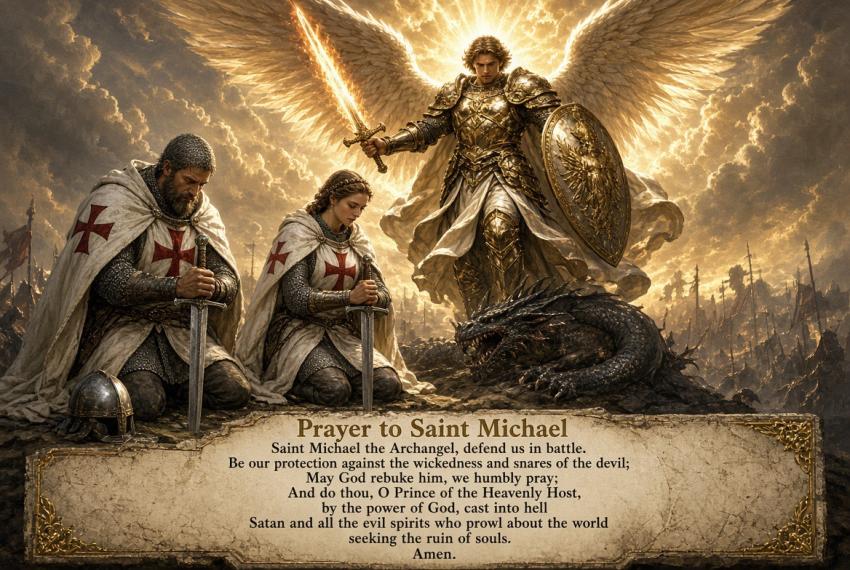
Saint Michael the Archangel: Six Times He Came to Earth, and What Each Visit Cost is a 34-minute documentary from the Hidden Halos channel (uploaded August 19, 2026). It traces six reported apparitions of St. Michael across about 14 centuries, drawing from Church tradition, sanctuary records, and scholarship while distinguishing verified history from later legend. 
The six accounts
Monte Gargano, Italy (c. 490)
A landowner shoots an arrow at a bull in a mountain cave; the arrow turns in mid-... moreSaint Michael the Archangel: Six Times He Came to Earth, and What Each Visit Cost is a 34-minute documentary from the Hidden Halos channel (uploaded August 19, 2026). It traces six reported apparitions of St. Michael across about 14 centuries, drawing from Church tradition, sanctuary records, and scholarship while distinguishing verified history from later legend. 
The six accounts
Monte Gargano, Italy (c. 490)
A landowner shoots an arrow at a bull in a mountain cave; the arrow turns in mid-air and wounds him. Bishop Lorenzo of Siponto fasts and prays. Michael appears, claims the cave as his sanctuary, and later directs a timed attack that lifts a siege. When the bishop finally enters, an altar and a footprint are already there. The Sanctuary of Monte Sant’Angelo remains a major pilgrimage site.
Rome during the plague (590)
Pope Gregory (later Gregory the Great) leads processions. A figure of light is seen sheathing a sword above Hadrian’s Mausoleum. The plague recedes. The site becomes Castel Sant’Angelo. The written account appears centuries later, so the details are treated as tradition rather than contemporary report.
Mont Saint-Michel, Normandy (708)
Bishop Aubert of Avranches receives three visions instructing him to build an oratory on the tidal island. He delays twice. On the third visit Michael is said to have pierced his skull. Aubert’s skull, with a hole, is still displayed in Avranches. Construction of the famous abbey follows.
San Miguel del Milagro, Mexico (1631)
Seventeen-year-old Diego Lázaro, a recent indigenous convert, sees Michael during a procession and is told of a healing spring. Afraid no one will believe him, he stays silent, falls ill with fever, and is healed by Michael, who then leads him to the spring. After further illness he delivers the message. A shrine is established; Diego dies at 20 and is buried there. Contemporary investigations and the surviving spring are better documented than some of the earlier European stories.
Pope Leo XIII (1880s)
During Mass the pope is said to have seen demonic spirits over Rome. He composes the Prayer to St. Michael, which was recited after Low Mass worldwide until 1964. The core fact of the prayer’s composition is solid; the dramatic vision details are second-hand and later embellished.
The video’s epilogue frames the stories around hesitation, obedience, and the cost of delay or silence rather than spectacular miracles
https://youtu.be/Mh5mVCBcjiA?is=bzH8TLmUWpVHdpf3
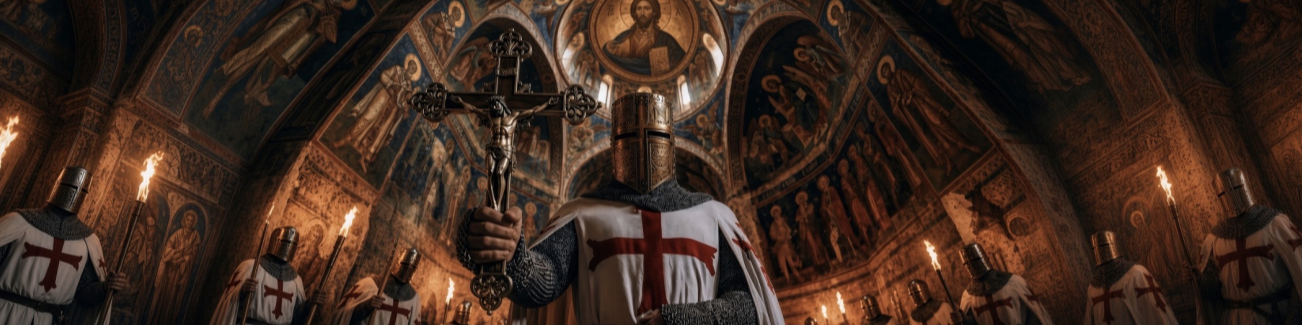
The Knights Templar greatly revered Our Lady, the Blessed Virgin Mary, who was considered the Order’s patroness. Bernard the Clairvaux, the spiritual godfather of the Knights Templar, was a one of the most devout Marianists in the history of the Catholic Church. It is no coincidence that the Knights’ Templar prayers during their imprisonment contained the words “May Mary, Star of the Sea, lead us to the harbor of salvation.”
Salve Regina drawn from the Latin rite used in Jerusalem, associated ... moreThe Knights Templar greatly revered Our Lady, the Blessed Virgin Mary, who was considered the Order’s patroness. Bernard the Clairvaux, the spiritual godfather of the Knights Templar, was a one of the most devout Marianists in the history of the Catholic Church. It is no coincidence that the Knights’ Templar prayers during their imprisonment contained the words “May Mary, Star of the Sea, lead us to the harbor of salvation.”
Salve Regina drawn from the Latin rite used in Jerusalem, associated with the Holy Sepulchre in the Crusader period. It is not a unique Templar composition. The antiphon itself is older — commonly linked to Hermann of Reichenau in the 11th century, later taken up at Cluny and among the Cistercians. St. Bernard of Clairvaux, who gave the Order its spiritual charter, was a fierce Marian and helped spread the Salve. The Templars inherited that devotion: Mary as patroness, Stella Maris, advocate for men who lived between chapel and battlefield.
https://youtu.be/uZT5Hy-i7C8?is=0OWiKsf5JASfo7Q6
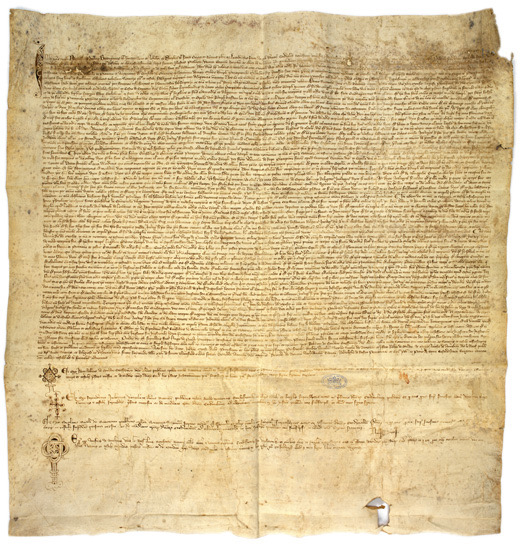
THE PARCHMENT OF CHINON – THE ABSOLUTION OF POPE CLEMENT V OF THE LEADING MEMBERS OF THE TEMPLAR ORDER
Chinon, Diocese of Tours, 1308 August 17th-20th
Original document formed by a large parchment folio (700x580mm), initially provided with the hanging seals of the three papal legates who formed the special Apostolic Commission ad inquirendum appointed by Clement V: Bérenger Frédol, Cardinal Priest of the titular church of the Most Holy Nereus and Achilleus and nephew of the pope, Étienne de... moreTHE PARCHMENT OF CHINON – THE ABSOLUTION OF POPE CLEMENT V OF THE LEADING MEMBERS OF THE TEMPLAR ORDER
Chinon, Diocese of Tours, 1308 August 17th-20th
Original document formed by a large parchment folio (700x580mm), initially provided with the hanging seals of the three papal legates who formed the special Apostolic Commission ad inquirendum appointed by Clement V: Bérenger Frédol, Cardinal Priest of the titular church of the Most Holy Nereus and Achilleus and nephew of the pope, Étienne de Suisy, cardinal priest of St. Cyriac in Thermis, Landolfo Brancacci, cardinal deacon of St. Angelo. In a reasonable state, even though there are some big violaceous stains, caused by bacterial attack. The original one came along with a plain copy still kept at the Vatican Secret Archives, with the reference Archivum Arcis, Armarium D 218.
ASV, Archivum Arcis, Arm. D 217
The document contains the absolution Pope Clement V gave to the Grand Master of the Temple, friar Jacques de Molay and to the other heads of the Order, after they had shown to be repented and asked to be forgiven by the Church; after the formal abjuration, which is compelling for all those who were even only suspected of heretical crimes, the leading members of the Templar Order are reinstated in the Catholic Communion and readmitted to receive the sacraments. The document, which belongs to the first phase of the trial against the Templars, when Pope Clement V was still convinced to be able to guarantee the survival of the military-religious order, meets the apostolic need to remove the shame of excommunication from the warrior friars, caused by their previous denial of Jesus Christ when tortured by the French Inquisitor. As several contemporary sources confirm, the pope ascertained that Templars were involved in some serious forms of immorality and he planned a radical reform of the order to subsequently merge it into one body with the other important military-religious order of the Hospitallers. The Act of Chinon, a requirement to carry out the reform, remained however a dead letter. The French Monarchy reacted by initiating a real blackmail mechanism, which would have then obliged Clement V to take a final decision during the Council of Vienna (1312): unable to oppose the will of the King of France, Phillip the Fair, who ordered the elimination of the Templars, the Pope, heard the opinion of the Council Fathers, and decided to abolish the Order «con norma irreformabile e perpetua» (bull Vox in excelso, 22nd March 1312). Clement V however stated that this suffered decision did not amount to an act of heretic condemnation, which could not be reached on the basis of the various inquiries carried out in the years prior to the Council. As a matter of fact, a regular trail would have been required in order to pass a sentence, including also the statement of the defensive position of the Order. But, according to the pontiff, the scandal aroused by the shameful accusations against the Templars (heresy, idolatry, homosexuality and obscene behaviour) would have dissuaded anyone, from wearing the templar habit and on the other hand, a delay on a decision regarding these issues would have produced the squandering of the great wealth the Christians had offered to the Order, charged with the duty to help fight against the enemies of the Faith in the Holy Land. The attentive consideration of these dangers, together with the pressure of the French, convinced the Pope to abolish the Order of the Knights of the Temple, just like had happened in the past for much more important religious orders and for much less important reasons.
Brothers and Sisters,
Today, September 14, is the Feast of the Exaltation of the Holy Cross (also called the Triumph of the Cross).
Helena, mother of Constantine, around 326 in Jerusalem. Three crosses were unearthed near Calvary; the True Cross was identified when it miraculously healed a dying woman.
Church of the Holy Sepulchre was dedicated on 13 September 335.
The relic was solemnly exalted before the people the next day—14 September—and the feast was born.
In 614 the relic was carri... more
Brothers and Sisters,
Today, September 14, is the Feast of the Exaltation of the Holy Cross (also called the Triumph of the Cross).
Helena, mother of Constantine, around 326 in Jerusalem. Three crosses were unearthed near Calvary; the True Cross was identified when it miraculously healed a dying woman.
Church of the Holy Sepulchre was dedicated on 13 September 335.
The relic was solemnly exalted before the people the next day—14 September—and the feast was born.
In 614 the relic was carried off by the Persians; Emperor Heraclius defeated them and returned it to Jerusalem in 628–630. Tradition says he first approached in imperial splendor and could not enter; only after he laid aside his robes and walked barefoot, in humility like Christ, could he restore the Cross.
“Of all the holy and wonderful places, the Sepulchre somehow holds first rank. I do not know why a greater devotion is felt at the place where He lay dead than at the places where He did things while alive, or why the memory of His death moves us more than the memory of His life.
His life has given me a pattern for living; His death, a release from death. The one prepared life; the other destroyed death. His life was laborious, His death precious—and both are necessary. What would His death profit the man who lives badly? What would His life profit the man who dies under condemnation?
He came, then, that we might learn by His life to live in holiness, and by His death to die in confidence. He died as one destined to rise, and to those who undergo death He brought the hope of rising again. He added a third gift, without which the other two would be nothing: the remission of sins.
Man stood condemned to a double death in his double nature—one spiritual and voluntary, the other bodily and forced. The God-Man healed both by one bodily and voluntary death. Dying once, He killed our two deaths. He took our debt without sharing our sin. If He had not suffered in the body, He would not have paid the debt; if the death had not been voluntary, it would have had no merit.”
Chapter 11 — The Holy Sepulchre
St. Bernard of Clairvaux, Liber ad milites Templi de laude novae militiae (c. 1130)
We adore You, O Christ, and we bless You,
because by Your holy Cross You have redeemed the world
CAA Patricia Fraser
Priory of St. Michael the Archangel
Fides Et Veritas
I saw something the other day, which reminded me of when I was in the U.S. military. It was something to the affect of gaining rank. Through my years of experience, I know it takes time, trust, skill, knowledge and experience. Take the time to read, research, move out of your comfort zone and stand strong.
Rank is hard to make and easy to lose.
Scripture already named the reason:
“From everyone who has been given much, much will be required; and from the one who has been entrusted with much, ... moreI saw something the other day, which reminded me of when I was in the U.S. military. It was something to the affect of gaining rank. Through my years of experience, I know it takes time, trust, skill, knowledge and experience. Take the time to read, research, move out of your comfort zone and stand strong.
Rank is hard to make and easy to lose.
Scripture already named the reason:
“From everyone who has been given much, much will be required; and from the one who has been entrusted with much, even more will be demanded.”
— Luke 12:48
The stripe, the title, the authority is not a trophy. It is a trust. The work that earns it is slow, hidden, and often thankless. The moment it is given, the standard rises. More eyes. More souls depending on you. Less room for pride, shortcuts, or the old excuses.
That is why so many want the rank before the work. They want the honor without the yoke. They confuse the symbol with the substance. They forget that rank is earned, not owned — and the rent is paid every day in faithfulness, example, and accountability.
“Whoever exalts himself will be humbled, and whoever humbles himself will be exalted.”
— Matthew 23:12
Do the work first. Carry the load when no one is pinning anything on you. Then, if God and those over you place the rank in your hands, keep earning it. The ones who treat it as already paid for are usually the ones who lose it first.
“Humble yourselves, therefore, under the mighty hand of God so that at the proper time He may exalt you.”
— 1 Peter 5:6
Remember who we work for: Non nobis, Domine, non nobis, sed nomini tuo da gloriam.
“Not unto us, O Lord, not unto us, but to Thy name give glory.”
Yours In Christ,
Always a servant,
CAA Patricia Fraser
Priory of St. Michael the Archangel
Fides Et Veritas












Priory of the Holy Trinity
Dieu Avec Nou