

John 19:30-34 So when Jesus had received the sour wine, He said, “It is finished!” And bowing His head, He gave up His spirit. Therefore, because it was the Preparation Day, that the bodies should not remain on the cross on the Sabbath (for that Sabbath was a high day), the Jews asked Pilate that their legs might be broken, and that they might be taken away. Then the soldiers came and broke the legs of the first and of the other who was crucified with Him. But when they came to Jesus and saw that He was already dead, they did not break His legs. But one of the soldiers pierced His side with a spear, and immediately blood and water came out.
Matthew 27:54 So when the centurion and those with him, who were guarding Jesus, saw the earthquake and the things that had happened, they feared greatly, saying, “Truly this was the Son of God!”
Mark 15:39 So when the centurion, who stood opposite Him, saw that He cried out like this and breathed His last, he said, “Truly this Man was the Son of God!”
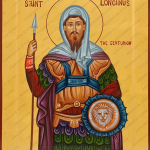
According to Church Tradition, Longinus the Centurion was the Roman soldier who pierced the side of the Crucified Savior with a spear. He also received healing from an eye affliction when blood and water poured forth from the wound. Afterwards, he loudly proclaimed “Truly this was the Son of God”.
After the Crucifixion and Burial of the Savior, Longinus stood watch with his company at the Sepulcher of the Lord. These soldiers were present at the All-Radiant Resurrection of Christ. The Jews bribed them to lie and say that His disciples had stolen away the Body of Christ, but Longinus and two of his comrades refused to be seduced by the Jewish gold. They also refused to remain silent about the miracle of the Resurrection.
Having come to believe in the Savior, the soldiers received Baptism from the apostles and decided to leave military service. Saint Longinus left Judea to preach about Jesus Christ the Son of God in his native land (Cappadocia), and his two comrades followed him.
The fiery words of those who had actually participated in the great events in Judea swayed the hearts and minds of the Cappadocians; Christianity began quickly to spread throughout the city and the surrounding villages. When they learned of this, the Jewish elders persuaded Pilate to send a company of soldiers to Cappadocia to kill Longinus and his comrades. When the soldiers arrived at Longinus’s village, the former centurion himself came out to meet the soldiers and took them to his home. After a meal, the soldiers revealed the purpose of their visit, not knowing that the master of the house was the very man whom they were seeking. Then Longinus and his friends identified themselves and told the startled soldiers to carry out their duty.
The soldiers wanted to let the saints go and advised them to flee, but they refused to do this, showing their firm intention to suffer for Christ. The holy martyrs were beheaded, and their bodies were buried at the place where the saints were martyred. The head of Saint Longinus, however, was sent to Pilate.
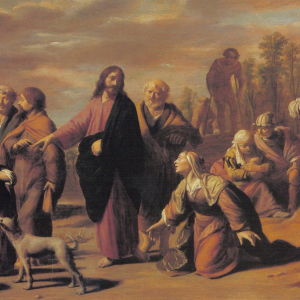
Pilate gave orders to cast the martyr’s head on a trash-heap outside the city walls. After a while a certain blind widow from Cappadocia arrived in Jerusalem with her son to pray at the holy places, and to ask that her sight be restored. After becoming blind, she had sought the help of physicians to cure her, but all their efforts were in vain.
The woman’s son became ill shortly after reaching Jerusalem, and he died a few days later. The widow grieved for the loss of her son, who had served as her guide.
Saint Longinus appeared to her in a dream and comforted her. He told her that she would see her son in heavenly glory, and also receive her sight. He told her to go outside the city walls and there she would find his head in a great pile of refuse. Guides led the blind woman to the rubbish heap, and she began to dig with her hands. As soon as she touched the martyr’s head, the woman received her sight, and she glorified God and Saint Longinus.
Taking up the head, she brought it to the place she was staying and washed it. The next night, Saint Longinus appeared to her again, this time with her son. They were surrounded by a bright light, and Saint Longinus said, “Woman, behold the son for whom you grieve. See what glory and honor are his now, and be consoled. God has numbered him with those in His heavenly Kingdom. Now take my head and your son’s body, and bury them in the same casket. Do not weep for your son, for he will rejoice forever in great glory and happiness.”
The woman carried out the saint’s instructions and returned to her home in Cappadocia. There she buried her son and the head of Saint Longinus. Once, she had been overcome by grief for her son, but her weeping was transformed into joy when she saw him with Saint Longinus. She had sought healing for her eyes, and also received healing of her soul.
Another interesting aspect to the story of Longinus is the spear used to pierce the side of Jesus called variously the Spear of Longinus, also known as the Holy Lance or Spear of Destiny. It has its own intricate history as a highly revered relic, often associated with supernatural power and sought by historical figures. Multiple, distinct relics claiming to be the Spear exist in Rome, Vienna, Vagharshapat, and Antioch.
Troparion — Tone 1
Longinus, you beheld the King of Glory
Who was nailed to the Cross, yet shone on those in darkness.
You were enlightened by His rays and became a martyr
And save those who cry:
Glory to Him who gave you strength!
Glory to Him who granted you a crown!
Glory to Him who through you grants healing to all!
Kontakion — Tone 4
The Church rejoices in gladness
On the day of the commemoration of the ever-memorable athlete Longinus!
She cries out: “You are my strength and support, O Christ!”


CAA George Peterson
Priory of St. Helena
“Post Tenebras Lux”
Light after Darkness