
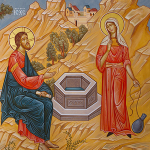

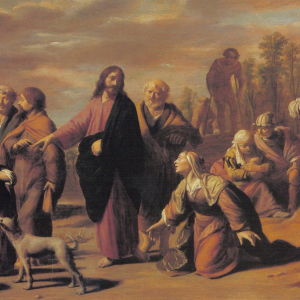

The New Testament recounts the well-known narrative of the Samaritan woman (John 4:5-42). Prior to this encounter, she had led a sinful life, which resulted in a rebuke from Jesus Christ. However, she responded to Christ’s stern admonition with genuine repentance, was forgiven for her sinful ways, and became a convert to Christianity—taking the name “Photini” at Baptism, which literally translates to “the enlightened one.”
A significant figure in the early church, the Samaritan Woman, like many other women, played a crucial role in the spread of Christianity. Consequently, she holds a prominent position among the apostles. In Greek sermons from the fourth to the fourteenth centuries, she is referred to as “apostle” and “evangelist.” In these sermons, the Samaritan Woman is frequently compared to the male disciples and apostles and is found to surpass them.
Subsequently, Byzantine hagiographers developed the story of the Samaritan Woman, continuing where Saint John left off. At Pentecost, Saint Photini received baptism, accompanied by her five sisters: Anatole, Photo, Photis, Paraskeve, and Kyriake, as well as her two sons, Photeinos and Joseph. Subsequently, she embarked on a missionary journey, traveling extensively to preach the good news of the Messiah’s coming, His death, and resurrection.
During the reign of Emperor Nero, who initiated a persecution of Christians, Photini and her son Joseph were residing in Carthage, Africa, where she was actively preaching the Christian gospel. After Jesus appeared to Photini in a dream, she embarked on a journey to Rome. Her son and numerous Christians from Africa accompanied her. Photini’s arrival and activities in the capital city generated widespread curiosity. People were eager to learn about her, inquiring, “Who is this woman?” They were further intrigued by her presence with a large group of followers and her unwavering boldness in preaching Christ.
In response to the growing attention, soldiers were dispatched to apprehend Photini. However, she anticipated their arrival. Before they could detain her, Photini, accompanied by her son Joseph and her Christian companions, approached Nero. Upon their presence, the emperor inquired about their purpose. Photini responded, “We have come to instruct you in the belief in Christ.” The eccentric ruler of the Roman Empire remained unfazed by her words. Instead, he expressed a desire to convert her. Nero requested the names of the saints present. Photini, with her characteristic candor, introduced herself, her five sisters, and her younger son.
The emperor then demanded to know whether they had all agreed to die for the Nazarene. Photini spoke for them. “Yes, for the love of Him we rejoice and in His name we’ll gladly die.” Hearing their defiant words, Nero ordered their hands beaten with iron rods for three hours. At the end of each hour, another persecutor took up the beating. The saints, however, felt no pain. Nothing happened to their hands. Photini joyfully quoted words of a psalm by David: “God is my help. No matter what anyone does to me, I shall not be afraid.” Perplexed by the Christian’s endurance and confidence, Nero ordered the men thrown into jail.
Photini and her five sisters were brought to the golden reception hall in the imperial palace. There, the six women were seated on golden thrones, in front of them stood a large golden table covered with gold coins, jewels, and dresses. Nero hoped to tempt the women by this display of wealth and luxury. Nero then ordered his daughter Domnina, with her slave girls, to go speak with the Christian women. Women, he thought, would succeed in persuading their Christian sisters to deny their God.
Domnina greeted Photini graciously, mentioning the name of Christ. On hearing the princess’ greeting, the saint thanked God. She then embraced and kissed Domnina. The women talked. But the outcome of the women’s talk was not what Nero wished. Photini catechized Domnina and her hundred slave girls and baptized them all. She gave the name Anthousa to Nero’s daughter. After her baptism, Anthousa immediately ordered all the gold and jewels on the golden table distributed to the poor of Rome.Upon learning of his daughter’s conversion to Christianity, Emperor Nero condemned Photini and her companions to death by fire. For seven days, the furnace burned, but when the door was opened, it was discovered that the fire had not harmed the saints. Subsequently, Nero attempted to destroy the saints with poison, offering to be the first to drink it. “O King,” she declared, “I will drink the poison first so that you may witness the power of my Christ and God.” All the saints then drank the poison after her, and none suffered any adverse effects.
In vain did Nero subject Photini, her sisters, sons, and friends to every known form of torture. The saints survived unscathed, taunting and ridiculing their persecutor. For three years, they were held in a Roman prison, which Saint Photini transformed into a “house of God.” Many Romans visited the prison, were converted, and baptized.
Finally, the enraged tyrant ordered the beheading of all the saints, except for Photini. She was first thrown into a deep, dry well and then imprisoned again. Photini now grieved the solitude of her situation, lamenting that she had not received the crown of martyrdom alongside her five sisters, Anatole, Photo, Photis, Paraskeve, and Kyriake, and her two sons, Photeinos and Joseph. Night and day, she prayed for release from this life. Many days later, while she sang hymns and blessed God, Saint Photini entrusted her soul to God’s hands.
The Samaritan Woman conversed with Christ at the well of Jacob, near the city of Sychar. She drank from the “living water” and gained everlasting life and glory.
Troparion to St. Photini
Illuminated by the Holy Spirit, All-Glorious One,
from Christ the Saviour you drank the water of salvation.
With open hand you give it to those who thirst.
Great-Martyr Photini, Equal-to-the-Apostles,
pray to Christ for the salvation of our souls.