

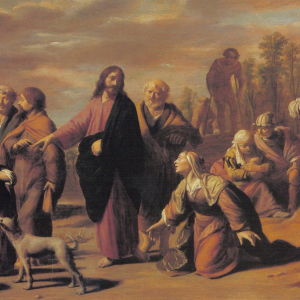
The account of the woman with an issue of blood, who had the unusual name of Veronica, (also known as Berenike (or Berenice); an Ancient Greek name meaning "she who brings victory”) may be found in the Gospel according to Saint Matthew (9:20-22), in Saint Mark's Gospel (5:25-34), and also in Saint Luke's Gospel (8:43-49).
The Synaxaristes of Saint Νikόdēmos of the Holy Mountain states that this Saint was from the city of Caesarea Philippi. When the Lord healed her issue of blood, she was very grateful, because for twelve years she had "suffered much under many physicians, and had spent all that she had, and nothing had helped, but instead she became worse" (Mark 5:26).
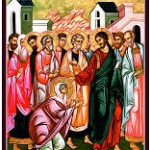
Mark 5:34 She had heard of Christ, and decided to go to Him, believing that she would be healed merely by touching His garment. When she did this, the Savior felt that power had gone forth from Him. Turning to the crowd, He asked who had touched His garment. His disciples were puzzled by the question, since many people were pressing Him on all sides. Saint Veronica came forward and fell down before Him in fear and trembling, and admitted what she had done. The Lord said, "Daughter, your faith has made you well; go in peace, and be healed of your affliction".
Saint Veronica became a member of the early Church. In her gratitude, she made a statue of Him and placed it in front of her house, where everyone could venerate it. A healing plant grew at the base of the statue, which was able to cure various diseases. The Orthodox Church honors her memory on July 12.
Troparion — Tone 8
The image of God was truly preserved in you, O Mother,
For you took up the Cross and followed Christ.
By so doing, you taught us to disregard the flesh, for it passes away,
But to care instead for the soul, since it is immortal.
Therefore your spirit, O Holy Mother Veronica, rejoices with the Angels!