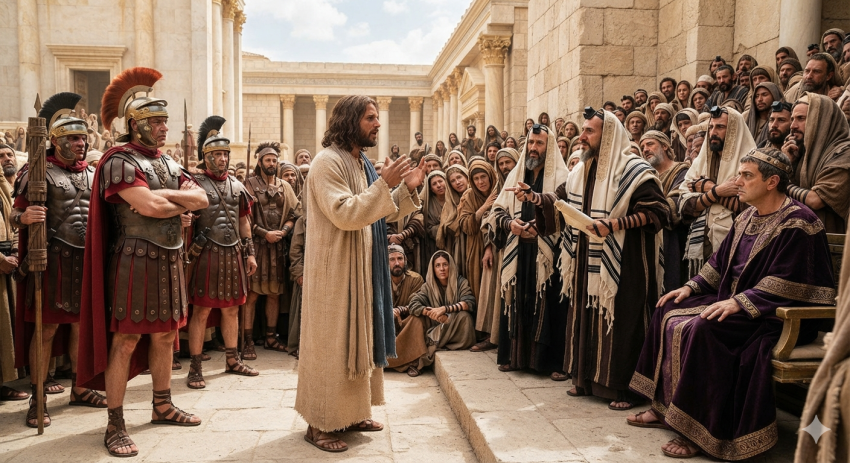
Thought you'd all find this interesting; I participated in a Bible Study this week that attempted to define Jesus utilizing modern political orientations. Reminding my group members that THIS is largely a futile exercise, I made the following argument just for arguments sake...Enjoy, and Deus Vult!
The argument that Jesus was a libertarian rests on his consistent defense of individual liberty, voluntary charity, and strict limitations on political power. Christian libertarians argue that while ... moreThought you'd all find this interesting; I participated in a Bible Study this week that attempted to define Jesus utilizing modern political orientations. Reminding my group members that THIS is largely a futile exercise, I made the following argument just for arguments sake...Enjoy, and Deus Vult!
The argument that Jesus was a libertarian rests on his consistent defense of individual liberty, voluntary charity, and strict limitations on political power. Christian libertarians argue that while Jesus held humanity to an incredibly high moral standard, he always advocated for these choices to be made through free will rather than state-enforced coercion. By analyzing his actions and teachings, proponents of this view argue that his message aligns cleanly with the modern libertarian emphasis on private property, the non-aggression principle, and deep skepticism toward centralized government authorities.First, libertarians emphasize that Jesus viewed charity as a purely voluntary virtue rather than a mandate for state redistribution. In the Parable of the Workers in the Vineyard (Matthew 20:15), a landowner asserts his economic autonomy, asking, "Don’t I have the right to do what I want with my own money?"
Furthermore, when Jesus challenges the Rich Young Ruler in Matthew 19:21 to "go, sell your possessions and give to the poor," he issues a personal, moral invitation to the individual's conscience. He notably never appeals to the Roman Empire or local tax authorities to confiscate wealth by force to achieve economic equity.Second, Jesus established clear boundaries between secular governance and personal liberty, which libertarians interpret as a severe restriction on state authority. When questioned about paying taxes in Matthew 22:21, he famously replied, "So give back to Caesar what is Caesar’s, and to God what is God’s." Rather than endorsing total government control, this division implies that Caesar’s legitimate jurisdiction is heavily constrained. Because an individual's soul, mind, and labor ultimately belong to God, they remain entirely outside the rightful ownership or regulation of the state.Third, Jesus demonstrated a profound skepticism toward political power and rejected top-down, authoritarian rule. In Matthew 20:25-26, he directly warns his disciples against replicating the coercive structures of secular governments, stating, "You know that the rulers of the Gentiles lord it over them... Not so with you. Instead, whoever wants to become great among you must be your servant." He actively resisted political institutions, even fleeing to a mountain in John 6:15 when a crowd "intended to come and make him king by force." He later affirmed to Pontius Pilate in John 18:36 that his kingdom was not of this world, precisely because it did not rely on military or state enforcement.
Finally, Jesus’s teachings strongly mirror the libertarian Non-Aggression Principle (NAP), which forbids the initiation of force against others. When his disciple Peter draws a weapon to violently resist arrest in Gethsemane, Jesus forcefully rebukes him in Matthew 26:52, commanding, "Put your sword back in its place, for all who draw the sword will die by the sword." By rejecting institutional violence and coercive political systems, Jesus championed a framework where social cooperation must be entirely peaceful and consensual. Together, these scriptural arguments form the basis for viewing Jesus as a teacher who prioritized individual liberty over the power of the state.