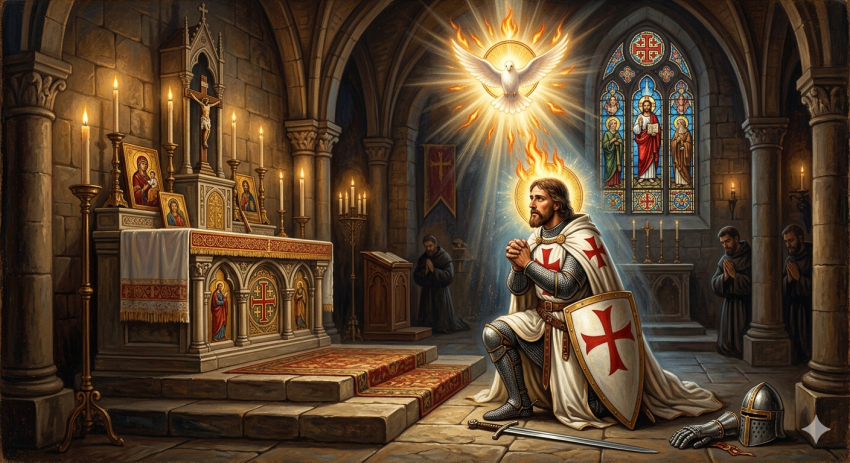
Today's Gospel reading is from John 14:21-26, where Jesus tells his disciples, "Whoever has my commandments and observes them is the one who loves me." For a Knight Templar, this passage serves as the foundational "Rule" for his dual existence as both a monk and a warrior. The Templar did not see his sword and his rosary as conflicting instruments, but as unified tools of obedience. To "keep the commandments" in the heat of battle meant maintaining a disciplined heart, ensuring that his violence... moreToday's Gospel reading is from John 14:21-26, where Jesus tells his disciples, "Whoever has my commandments and observes them is the one who loves me." For a Knight Templar, this passage serves as the foundational "Rule" for his dual existence as both a monk and a warrior. The Templar did not see his sword and his rosary as conflicting instruments, but as unified tools of obedience. To "keep the commandments" in the heat of battle meant maintaining a disciplined heart, ensuring that his violence was never rooted in malice or personal gain, but in the sacrificial protection of the faithful.
The Gospel further promises that the Father will love those who love Christ, and that "we will come to him and make our dwelling with him." For the medieval Templar, whose life was defined by the abandonment of personal property and familial titles, this internal "dwelling" was his only true home. Whether stationed in a cold preceptory or a desert fortress, the knight’s strength was predicated on the belief that he carried the presence of God within his very armor. This indwelling provided the supernatural fortitude required to face overwhelming odds, transforming the physical battlefield into a spiritual enclosure where the soul remained anchored in divine love despite the surrounding chaos.
Finally, Jesus promises the Advocate, the Holy Spirit, who "will teach you everything and remind you of all that I told you." This specific grace is vital for the Templar’s discernment. In the complex moral landscape of the Crusades, the Spirit acted as the knight’s internal compass, reminding him that his ultimate allegiance was not to a grandmaster or a king, but to the Eternal Word. By relying on this divine "Remembrancer," the Templar sought to embody the perfect balance of the Militia Christi: a warrior who is fierce in the defense of the weak, yet remains a humble student of the Peace of Christ, perpetually ready to lay down his life for the Truth he has been taught.