The Virtue That Survives Every Storm."
Anyone can be loyal when it costs nothing.
The true test begins when loyalty demands sacrifice. Most people remain loyal during times of success.
When friendships are strong, when recognition is abundant, and when standing firm requires little effort, loyalty appears easy. But history teaches us that loyalty is not measured in moments of comfort. It is measured in moments of adversity.
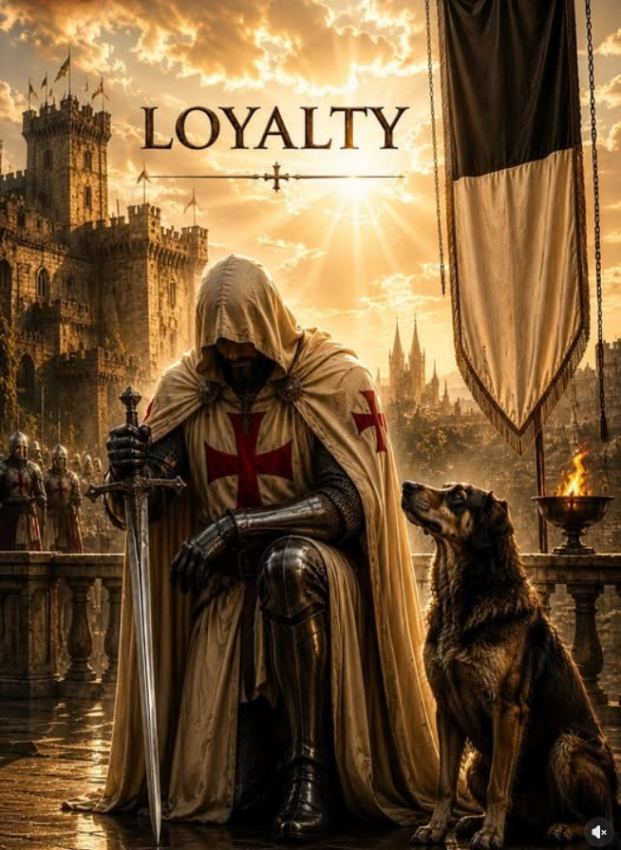
The Knights Templar were bound together by more than a military miss... moreThe Virtue That Survives Every Storm."
Anyone can be loyal when it costs nothing.
The true test begins when loyalty demands sacrifice. Most people remain loyal during times of success.
When friendships are strong, when recognition is abundant, and when standing firm requires little effort, loyalty appears easy. But history teaches us that loyalty is not measured in moments of comfort. It is measured in moments of adversity.
The Knights Templar were bound together by more than a military mission.
They shared a sacred oath.
An oath to God.
An oath to truth.
An oath to protect one another.
An oath that would define every decision they made.
For nearly two centuries, the Order became one of the most respected institutions in Christendom. Their courage on the battlefield, their discipline, and their unwavering commitment earned them honor throughout Europe and the Holy Land.
Yet loyalty is never truly proven in times of glory.
It is proven when everything begins to fall apart.
In October 1307, King Philip IV of France ordered the arrest of the Templars. In a single day, many knights lost their freedom, their status, and their security. They were imprisoned, interrogated, and subjected to enormous pressure. Their wealth was seized. Their reputation was attacked. Their future vanished overnight.
Faced with fear, suffering, and uncertainty, every man had a choice.
Some yielded under pressure. Others remained faithful to their vows despite the consequences.
For those men, loyalty was not blind obedience. It was the conviction that honor cannot be purchased, fear cannot redefine truth, and promises do not lose their value when circumstances change.
The Templars understood something that remains relevant today:
A person's character is revealed when loyalty becomes costly.
When friendships are tested.
When principles become unpopular.
When standing for truth requires sacrifice.
When abandoning one's commitments would be easier than keeping them.
That is where loyalty reveals its true nature.
The legacy of the Templars is not found merely in castles, swords, or legends.
It is found in the example of men who believed that a promise once given should not be abandoned when the road becomes difficult.
Because loyalty is not a feeling. It is a decision. A decision repeated every day.
When loyalty becomes costly, do you remain faithful to your principles—or only to your convenience?
Loyalty is not a feeling. It is a decision repeated every day.
GP Derek Nordio
OMSDT Knights Templar
Defenders of the Faith




CAA Michael Loos Sr.
Priory of St. Michael the Archangel
Fides Et Veritas