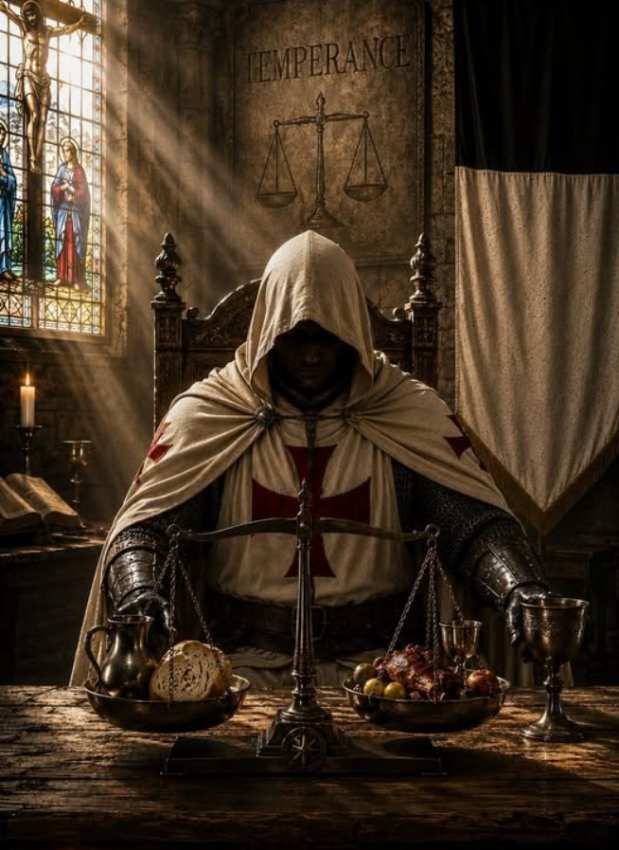
Virtue of Temperance
Most people believe a Templar became great through courage, martial skill, or prowess on the battlefield.
But one of the most important virtues of the Knights Templar had nothing to do with war.
It was temperance.
When we think of the Templars today, we often picture heavily armed knights charging into battle in the Holy Land.
Yet behind the sword stood a way of life that many people today would find difficult to imagine.
The Templars took vows. They renounced persona... moreVirtue of Temperance
Most people believe a Templar became great through courage, martial skill, or prowess on the battlefield.
But one of the most important virtues of the Knights Templar had nothing to do with war.
It was temperance.
When we think of the Templars today, we often picture heavily armed knights charging into battle in the Holy Land.
Yet behind the sword stood a way of life that many people today would find difficult to imagine.
The Templars took vows. They renounced personal wealth, luxury, and many of life's comforts. Not because they despised material things, but because they understood a profound truth:
A man who is ruled by his desires can never be truly free.
Temperance meant far more than simple restraint.
It was the ability to master one's desires rather than be mastered by them.
A knight could face an armed enemy on the battlefield.
But could he face his own pride?
Could he control his anger when insulted?
Could he exercise restraint when granted power?
Could he remain humble when praised by others?
The medieval rules of the military orders repeatedly emphasized self-discipline because it was seen as the foundation of every other virtue.
For courage without temperance becomes recklessness.
Strength without temperance becomes brutality.
Wealth without temperance becomes greed.
And power without temperance becomes tyranny.
Perhaps this is one of the greatest challenges of our own age.
We live in a world that constantly tells us to consume more, own more, desire more, and satisfy every impulse immediately.
The Templars might have asked a different question:
Do you control your desires, or do your desires control you?
True freedom does not begin when we are able to do anything we want.
It begins when we possess the strength not to do everything we can.
Temperance may seem like a quiet virtue.
Yet it often determines whether a person becomes master of himself—or prisoner of his own appetites.
GP Derek Nordio
OMSDT Knights Templar
Defenders of the Faith




CAA Michael Loos Sr.
Priory of St. Michael the Archangel
Fides Et Veritas