DANIEL 2
A Scripture-First Bible Study
Historic Protestant / Historic Adventist Perspective
Prepared for All
⸻
STUDY PRINCIPLE
“The testimony of the LORD is sure, making wise the simple.” (Psalm 19:7)
“Knowing this first, that no prophecy of the scripture is of any private interpretation.” (2 Peter 1:20)
Our objective is not to prove a denomination, but to let Scripture interpret Scripture and then compare it honestly with history.
⸻
INTRODUCTION
Daniel 2 is one of the greatest prophe... moreDANIEL 2
A Scripture-First Bible Study
Historic Protestant / Historic Adventist Perspective
Prepared for All
⸻
STUDY PRINCIPLE
“The testimony of the LORD is sure, making wise the simple.” (Psalm 19:7)
“Knowing this first, that no prophecy of the scripture is of any private interpretation.” (2 Peter 1:20)
Our objective is not to prove a denomination, but to let Scripture interpret Scripture and then compare it honestly with history.
⸻
INTRODUCTION
Daniel 2 is one of the greatest prophetic chapters in all of Scripture.
It is the foundation upon which much of biblical prophecy is built.
Jesus referred to Daniel.
The apostles accepted Daniel.
The book of Revelation builds upon Daniel’s prophecies.
Daniel 2 contains:
• King Nebuchadnezzar’s Dream
• The Forgotten Dream
• Daniel’s Prayer
• God’s Revelation
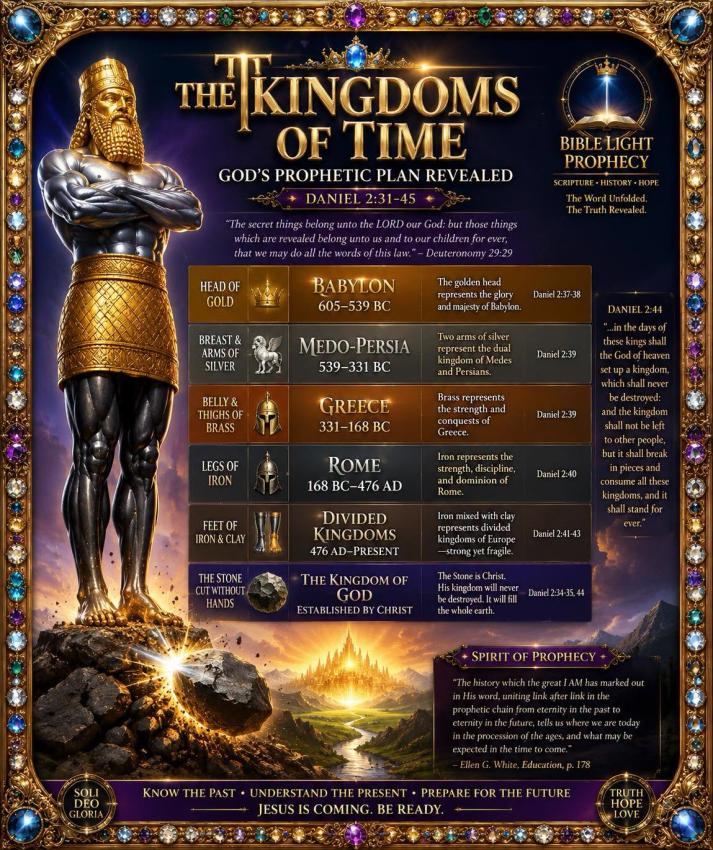
• The Great Image
• The Head of Gold
• The Breast and Arms of Silver
• The Belly and Thighs of Brass
• The Legs of Iron
• The Feet of Iron and Clay
• The Divided Kingdoms of Europe
• The Stone Cut Without Hands
• The Everlasting Kingdom of God
The question is:
Was this merely an ancient dream?
Or did God reveal the entire course of world history nearly six hundred years before Christ?
Historic Protestantism has long understood Daniel 2 as God’s prophetic outline of history from Babylon to the Second Coming.
Historic Adventists have continued this historic understanding, recognizing Daniel 2 as the foundation for understanding Daniel 7, 8, Revelation, and the final events.
⸻
THREE MAIN METHODS OF INTERPRETATION
1. Futurism
Many futurists accept the first kingdoms but often place the final kingdom almost entirely in the future.
Strengths:
• Recognizes Christ’s future kingdom.
Weaknesses:
• Often disconnects the prophecy from the continuous flow of history.
⸻
2. Preterism
Places much of Daniel within the ancient world.
Strengths:
• Gives attention to Babylon and the historical setting.
Weaknesses:
• Cannot naturally explain the complete sequence leading to Christ’s everlasting kingdom.
⸻
3. Historicism
Prophecy unfolds continuously throughout history.
Held by many Protestant Reformers including Luther, Calvin, Knox, Wesley, and developed further by early Seventh-day Adventist pioneers.
Question for discussion:
Which interpretation best follows the simple, uninterrupted sequence given by the text?
⸻
DANIEL 2:1–13
NEBUCHADNEZZAR’S DREAM
Read:
Daniel 2:1–13
Question:
Why did God give a pagan king this dream?
Because God rules over all nations.
He often speaks to rulers concerning His purposes.
Compare:
Genesis 41
Daniel 4
Acts 10
The dream was not for Nebuchadnezzar alone.
It was preserved for every generation.
⸻
THE FORGOTTEN DREAM
Question:
Why did God cause the king to forget the dream?
The wise men claimed supernatural wisdom.
God exposed their inability.
Only the true God could reveal both the dream and its interpretation.
Compare:
Isaiah 46:9–10
⸻
DANIEL’S PRAYER
Read:
Daniel 2:17–23
Question:
What did Daniel do before seeking an answer?
He prayed.
He gathered fellow believers.
He sought God’s mercy.
Question:
What lesson does this teach us?
Prophetic understanding begins with dependence upon God.
⸻
THE GOD OF HEAVEN REVEALS SECRETS
Daniel 2:28
“There is a God in heaven that revealeth secrets.”
Question:
Who receives the glory?
Not Daniel.
God alone.
Throughout Scripture,
true prophets always exalt God rather than themselves.
Compare:
John 3:30
Acts 3:12
⸻
THE GREAT IMAGE
Read:
Daniel 2:31–35
Question:
Why an image made of different metals?
Each section represents a successive world empire.
The image portrays the rise and fall of earthly kingdoms.
Notice:
The value of the metals decreases.
The strength increases.
Human governments become stronger militarily but weaker morally.
⸻
THE HEAD OF GOLD
Daniel 2:37–38
Question:
Who is the head of gold?
Babylon.
God identifies it directly.
Historical dates:
605–539 BC
Babylon was famous for:
Its wealth.
Its golden temples.
Its magnificent walls.
Its splendor.
Question:
Why gold?
Because Babylon was the wealthiest empire of its day.
⸻
THE BREAST AND ARMS OF SILVER
Daniel 2:39
Question:
Which kingdom followed Babylon?
The Medes and Persians.
Historical dates:
539–331 BC
Notice:
Two arms.
One kingdom composed of two peoples.
Compare:
Daniel 5
Daniel 8:20
⸻
THE BELLY AND THIGHS OF BRASS
Question:
Which kingdom conquered Medo-Persia?
Greece.
Historical dates:
331–168 BC
Led by Alexander the Great.
Greek culture spread throughout the known world.
Compare:
Daniel 8:21
Question:
Why brass?
Greek armor frequently used bronze.
⸻
THE LEGS OF IRON
Daniel 2:40
Question:
Which kingdom followed Greece?
Rome.
Historical dates:
168 BC–AD 476 (Western Empire)
Iron represents strength.
Rome crushed every nation before it.
Compare:
Daniel 7
Luke 2
Luke 23
John 19
Jesus lived and died during the Roman Empire.
⸻
THE FEET OF IRON AND CLAY
Daniel 2:41–43
Question:
What happens after Rome?
Rome is divided.
Not replaced by another universal empire.
The iron remains.
The clay is introduced.
Question:
What do the feet represent?
The divided nations of Europe.
Historically arising after the fall of Western Rome.
Question:
Why iron mixed with clay?
Some kingdoms remain strong.
Others weak.
They never permanently unite.
⸻
THEY SHALL NOT CLEAVE ONE TO ANOTHER
Daniel 2:43
Question:
Has Europe repeatedly attempted to reunite?
History records many attempts.
Charlemagne.
Charles V.
Napoleon.
Kaiser Wilhelm II.
Hitler.
The European Union has increased cooperation but has never produced one lasting universal empire.
Question:
Why?
Because God declared:
“They shall not cleave one to another.”
⸻
THE STONE CUT WITHOUT HANDS
Daniel 2:34–35
Question:
Who is the Stone?
Jesus Christ.
Compare:
Psalm 118:22
Isaiah 28:16
Matthew 21:42–44
Acts 4:11
Christ’s kingdom is not built by human effort.
It comes directly from heaven.
⸻
THE EVERLASTING KINGDOM
Daniel 2:44
Read carefully.
“In the days of these kings…”
Question:
When does God’s kingdom arrive?
During the divided kingdoms represented by the feet.
Not after another earthly empire.
The prophecy ends with Christ’s Second Coming and the establishment of His everlasting kingdom.
Question:
Will God’s kingdom ever pass away?
Never.
It alone is eternal.
⸻
THE IMAGE DESTROYED
Question:
What happens to earthly kingdoms?
The entire image is destroyed together.
Gold.
Silver.
Brass.
Iron.
Clay.
All disappear before God’s kingdom.
Earthly governments are temporary.
God’s kingdom is everlasting.
⸻
THE MOUNTAIN THAT FILLS THE EARTH
Question:
What does the mountain represent?
God’s eternal kingdom.
Compare:
Isaiah 2
Micah 4
Revelation 21–22
The kingdom of Christ will ultimately fill the whole earth.
⸻
HISTORICAL FULFILLMENT
Question:
Has history followed Daniel’s outline?
Babylon.
Medo-Persia.
Greece.
Rome.
Divided Europe.
Exactly as foretold.
Question:
What kingdom remains?
Only God’s everlasting kingdom.
⸻
SPIRIT OF PROPHECY
Ellen G. White wrote:
“We have no time to lose. Troublous times are before us. The world is stirred with the spirit of war. Soon the scenes of trouble spoken of in the prophecies will take place.” (Testimonies for the Church, vol. 9, p. 11.)
She also wrote:
“The history which the great I AM has marked out in His word, uniting link after link in the prophetic chain from eternity in the past to eternity in the future, tells us where we are today in the procession of the ages, and what may be expected in the time to come.” (Education, p. 178.)
Daniel 2 assures us that God is directing history. Kingdoms rise and fall, but His prophetic word never fails.
⸻
TOUGH QUESTIONS FOR THE STUDENT
1. Why did God reveal world history to a Babylonian king?
2. Why was Daniel able to reveal both the dream and its interpretation?
3. Why does the image move from precious metals to stronger but less valuable metals?
4. Why is Babylon specifically identified as the head of gold?
5. How do Daniel 2 and Daniel 7 parallel one another?
6. Why does Rome divide instead of being replaced by another universal empire?
7. Have history’s repeated attempts to unite Europe fulfilled Daniel 2:43?
8. Why is Christ represented as a stone cut without hands?
9. Why does the stone destroy the image rather than merely replace one section?
10. What does Daniel 2 teach about the temporary nature of earthly governments?
11. How does Daniel 2 strengthen confidence in Bible prophecy?
12. Which prophetic method—Historicist, Futurist, or Preterist—requires the fewest assumptions while remaining faithful to both Scripture and history?
⸻
FINAL THOUGHT
Daniel 2 is not merely a lesson about ancient empires.
It is a revelation of God’s absolute sovereignty over history.
Long before Babylon reached its height…
Long before Persia conquered…
Long before Alexander marched across the world…
Long before Rome ruled the nations…
God had already declared what would happen.
Every kingdom has risen exactly as foretold.
Every kingdom has fallen exactly as foretold.
Only one kingdom remains.
The kingdom of Jesus Christ.
Like the Bereans in Acts 17:11, may we search the Scriptures daily, compare prophecy with history honestly, and place our confidence—not in the kingdoms of men—but in the everlasting kingdom of God, “which shall never be destroyed.”
⚔️✝️✠ Lady Dinah Scivoletti ✠✝️📖⚔️
⚔️✝️✠ Joan of Arc Priory ✠✝️📖⚔️
⚔️✝️✠✠Act and God will Act (Actus et Deus Act)✠✠✝️📖⚔️