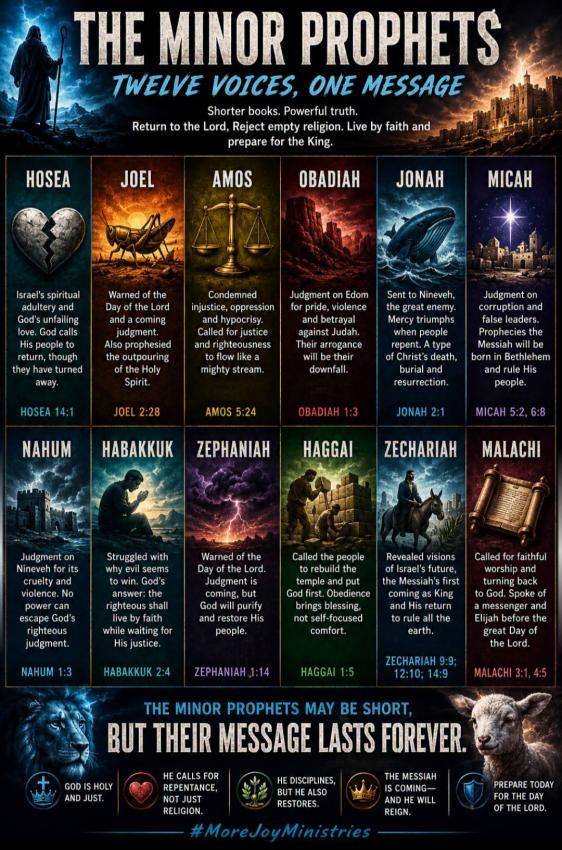
THE MINOR PROPHETS:
TWELVE VOICES, ONE MESSAGE
The final twelve books of the Old Testament are known as the Minor Prophets: Hosea, Joel, Amos, Obadiah, Jonah, Micah, Nahum, Habakkuk, Zephaniah, Haggai, Zechariah and Malachi.
They’re called “minor” because the books are shorter, not because their messages carry less authority. In Jewish tradition, these writings were often preserved together as one collection called the Book of the Twelve.
Some preached to Israel. Others warned Judah or surro... moreTHE MINOR PROPHETS:
TWELVE VOICES, ONE MESSAGE
The final twelve books of the Old Testament are known as the Minor Prophets: Hosea, Joel, Amos, Obadiah, Jonah, Micah, Nahum, Habakkuk, Zephaniah, Haggai, Zechariah and Malachi.
They’re called “minor” because the books are shorter, not because their messages carry less authority. In Jewish tradition, these writings were often preserved together as one collection called the Book of the Twelve.
Some preached to Israel. Others warned Judah or surrounding nations. Several spoke before the Assyrian and Babylonian invasions, while Haggai, Zechariah and Malachi ministered after the Jewish people returned from captivity.
Each prophet addressed a particular crisis, but together they reveal the same God: holy, patient, just, merciful and completely faithful to His covenant.
HOSEA
Hosea’s marriage became a living picture of Israel’s spiritual adultery. The nation had abandoned God for idols, yet God continued calling His people back.
Hosea exposes the pain of betrayal while showing the depth of divine mercy. Israel would be disciplined, but God hadn’t forgotten His covenant.
“O Israel, return unto the LORD thy God; for thou hast fallen by thine iniquity.”
-Hosea 14:1 KJV
JOEL
Joel used a devastating locust invasion to warn about the coming Day of the Lord. A greater judgment was approaching, and the nation needed to repent.
Joel also prophesied the outpouring of the Holy Spirit.
“And it shall come to pass afterward, that I will pour out my spirit upon all flesh.”
-Joel 2:28 KJV
Peter quoted this passage on the day of Pentecost, while parts of Joel’s prophecy still point toward future events surrounding the Day of the Lord.
AMOS
Amos was a herdsman whom God sent to confront the northern kingdom of Israel. The nation appeared prosperous, but corruption, oppression and religious hypocrisy had spread everywhere.
The people attended religious gatherings while mistreating the poor and ignoring righteousness.
“Let judgment run down as waters, and righteousness as a mighty stream.”
-Amos 5:24 KJV
Amos ends with the promise that God will restore the fallen tabernacle of David and plant Israel securely in the land.
OBADIAH
Obadiah is the shortest book in the Old Testament. Its message concerns Edom, the nation descended from Esau.
Edom had watched Jerusalem’s destruction with pride and taken advantage of Judah’s suffering. God declared that Edom’s violence, arrogance and betrayal would return upon its own head.
“The pride of thine heart hath deceived thee.”
-Obadiah 1:3 KJV
JONAH
Jonah was sent to Nineveh, the capital of Assyria, one of the most violent empires in the ancient world. He fled because he knew God might show mercy if the people repented.
After being swallowed by a great fish and delivered alive, Jonah entered Nineveh and preached judgment. The city repented, and God withheld destruction.
Jonah’s anger exposed the narrowness of his own heart. God cared about people Jonah wanted condemned.
The book also points toward Christ. Jesus compared His burial and resurrection to Jonah’s three days and nights in the fish.
MICAH
Micah condemned corrupt rulers, greedy landowners, false prophets and dishonest religious leaders. He warned that both Samaria and Jerusalem would face judgment.
He also foretold that the Messiah would be born in Bethlehem.
“But thou, Bethlehem Ephratah… out of thee shall he come forth unto me that is to be ruler in Israel.”
-Micah 5:2 KJV
Micah summarized faithful living with humility, mercy and justice.
“He hath shewed thee, O man, what is good.”
-Micah 6:8 KJV
NAHUM
More than a century after Jonah preached in Nineveh, the city had returned to violence and cruelty. Nahum announced that its destruction was now certain.
Nineveh appeared unconquerable, but no military power could protect it from God’s judgment. The city fell in 612 B.C., just as the prophet declared.
“The LORD is slow to anger, and great in power, and will not at all acquit the wicked.”
-Nahum 1:3 KJV
HABAKKUK
Habakkuk struggled with a question believers still ask: Why does God allow wickedness to continue?
God answered that He would use Babylon to judge Judah. Habakkuk then faced an even harder question: How could God use a nation more wicked than Judah as His instrument?
The answer wasn’t that Babylon would escape judgment. God would deal with every nation in His time. Habakkuk had to live by faith while waiting for God’s justice.
“The just shall live by his faith.”
-Habakkuk 2:4 KJV
That statement later became central to Paul’s explanation of justification by faith.
ZEPHANIAH
Zephaniah warned Judah about the approaching Day of the Lord. Idolatry, violence and spiritual complacency had filled the land.
His prophecy moves from local judgment to a worldwide reckoning, followed by the purification and restoration of God’s people.
“The great day of the LORD is near, it is near, and hasteth greatly.”
-Zephaniah 1:14 KJV
HAGGAI
Haggai preached after the Jewish people returned from Babylon. They had begun rebuilding the temple but abandoned the work while focusing on their own houses and comfort.
God confronted their misplaced priorities.
“Consider your ways.”
-Haggai 1:5 KJV
Once the people obeyed, construction resumed. Haggai reminded them that the restored temple’s humble appearance didn’t limit what God would accomplish through it.
ZECHARIAH
Zechariah ministered alongside Haggai but received far more extensive prophetic visions. His book speaks about Jerusalem, Israel’s restoration, the Messiah’s first coming and His future reign.
Zechariah foretold Christ entering Jerusalem on a donkey:
“Behold, thy King cometh unto thee… lowly, and riding upon an ass.”
-Zechariah 9:9 KJV
He also wrote of Israel looking upon the One they pierced, mourning and being cleansed.
“They shall look upon me whom they have pierced.”
-Zechariah 12:10 KJV
The book ends with the Lord returning, standing upon the Mount of Olives and ruling as King over all the earth.
MALACHI
Malachi addressed Israel after the temple had been rebuilt. Worship had become careless, the priests offered polluted sacrifices and the people had grown cynical about serving God.
Malachi announced that a messenger would prepare the way before the Lord. John the Baptist later fulfilled that role before Christ’s first coming.
“Behold, I will send my messenger, and he shall prepare the way before me.”
-Malachi 3:1 KJV
The book closes with a promise concerning Elijah before the great and dreadful Day of the Lord. After Malachi, the Old Testament record becomes silent for roughly four centuries until the events surrounding the birth of Jesus Christ.
THE MESSAGE OF THE TWELVE
The Minor Prophets deal with idolatry, injustice, pride, false worship, corrupt leadership, national judgment and the coming Day of the Lord. They also contain some of Scripture’s strongest promises of mercy, restoration and Messianic hope.
God repeatedly warned His people before judgment came. He sent prophets because He wanted repentance, not destruction. When nations refused correction, His patience didn’t erase His justice.
These books also prove that prophecy isn’t vague. Bethlehem was named as the Messiah’s birthplace. His entrance into Jerusalem was described. His piercing was foretold. Israel’s scattering, preservation and future restoration appear throughout the Twelve.
The Minor Prophets may be short, but they carry the entire weight of God’s authority. Their message still stands: return to the Lord, reject empty religion, live by faith and prepare for the King.
“The LORD shall be king over all the earth.”
-Zechariah 14:9 KJV
⚔️✝️✠1SGT Dinah Scivoletti✠✝️📖⚔️
⚔️✝️✠Joan of Arc Priory✠✝️📖⚔️
⚔️✝️✠Act and God will Act (Actus et Deus Act)✠✠✝️📖⚔️