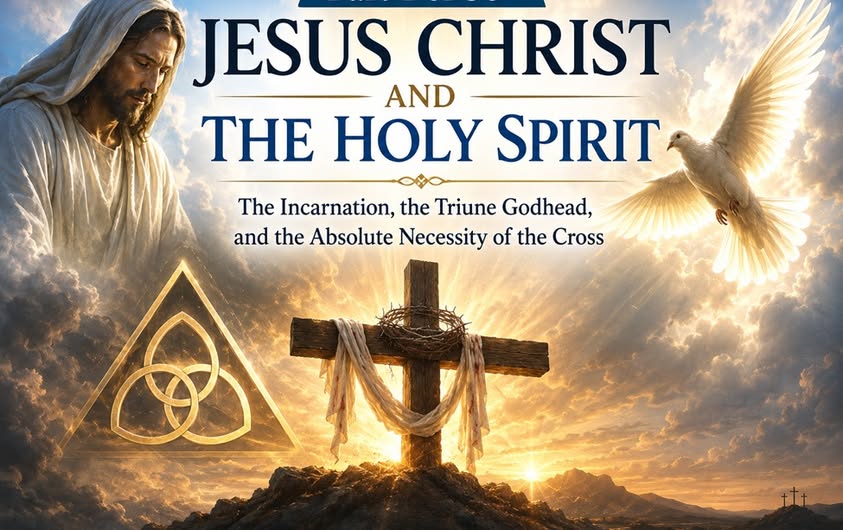
Part 1 of 8 - JESUS CHRIST AND THE HOLY SPIRIT
The Incarnation, the Triune Godhead, and the Absolute Necessity of the Cross
Introduction
Among the greatest truths revealed in Scripture are the identity of Jesus Christ and the ministry of the Holy Spirit. These truths stand at the very center of Christianity. If we misunderstand who Christ is, we will misunderstand salvation. If we misunderstand the Holy Spirit, we will misunderstand how God works in and through believers.
The Bible presents ... morePart 1 of 8 - JESUS CHRIST AND THE HOLY SPIRIT
The Incarnation, the Triune Godhead, and the Absolute Necessity of the Cross
Introduction
Among the greatest truths revealed in Scripture are the identity of Jesus Christ and the ministry of the Holy Spirit. These truths stand at the very center of Christianity. If we misunderstand who Christ is, we will misunderstand salvation. If we misunderstand the Holy Spirit, we will misunderstand how God works in and through believers.
The Bible presents Jesus Christ as fully God and fully man. He is not partly God and partly man, nor is He merely a great teacher, prophet, or religious reformer. He is God manifested in the flesh (1 Timothy 3:16). At the same time, He experienced genuine humanity. He became weary, hungry, sorrowful, and subject to the limitations of human existence apart from sin.
Likewise, the Holy Spirit is not merely a force, influence, or abstract power. He is the third Person of the Godhead, possessing mind, will, and emotion. He is active throughout Scripture, accomplishing the purposes of God among His people.
Understanding these truths reveals the beauty of God's plan of redemption. It shows why Christ had to come, why He had to die, why He had to rise again, and why the Holy Spirit was sent into the world.
This study seeks to examine these truths directly from Scripture.
The Mystery of the God-Man
The term "incarnate Christ" is a theological expression used to describe the astounding reality that Jesus of Nazareth was both fully God and fully man.
This truth is foundational.
When Jesus prayed to the Father, He prayed from the position of genuine humanity. He experienced every aspect of human existence except sin.
Scripture declares:
"For we have not an high priest which cannot be touched with the feeling of our infirmities; but was in all points tempted like as we are, yet without sin."
—Hebrews 4:15
Christ became tired.
He became hungry.
He experienced physical exhaustion.
He knew sorrow.
When Lazarus died, Jesus wept (John 11:35).
The grief of that household touched Him deeply. His tears were not artificial. They were not staged. They flowed from genuine compassion and human emotion.
Yet this same Jesus was fully God.
The One who wept at a tomb also stood before that tomb and commanded:
"Lazarus, come forth."
—John 11:43
And the dead man obeyed.
The same Jesus who slept in a boat during a storm stood up amid raging winds and crashing waves and simply spoke:
"Peace, be still."
—Mark 4:39
Immediately the sea became calm.
Imagine standing in that small fishing vessel.
The waves are crashing over the sides.
The wind is howling.
Experienced fishermen are convinced they are about to die.
Then one man stands and speaks a few words.
Suddenly nature obeys Him.
No wonder the disciples asked:
"What manner of man is this, that even the wind and the sea obey him?"
—Mark 4:41
The answer is clear.
He is the Creator Himself.
The One who calmed the sea was the very One who originally created it.
Why the Incarnation Was Necessary
The incarnation was not merely a beautiful theological truth.
It was absolutely necessary.
Without God becoming man, salvation would have been impossible.
Humanity stood condemned under sin.
The justice of God required payment.
The penalty for sin demanded death.
From the earliest pages of Scripture, God established the principle that redemption would involve sacrifice and blood.
After Adam's fall, God clothed him with skins (Genesis 3:21).
Abel offered a blood sacrifice (Genesis 4:4).
The entire Levitical system revolved around sacrificial blood.
Why?
Because God was teaching mankind a fundamental truth:
Sin requires death.
Sin requires blood.
Sin requires a substitute.
Yet spirit beings do not possess blood.
Angels cannot die as substitutes for humanity.
Therefore, the Son of God had to become man.
He had to possess a physical body.
He had to possess human blood.
He had to become qualified to die.
Hebrews declares:
"Forasmuch then as the children are partakers of flesh and blood, he also himself likewise took part of the same."
—Hebrews 2:14
The incarnation was not optional.
It was essential.
Without Bethlehem there could be no Calvary.
Without Calvary there could be no salvation.
The Triune Nature of God
One of the greatest objections raised by many religious groups concerns the doctrine of the Trinity.
The Jewish people rightly point to the declaration of Deuteronomy:
"Hear, O Israel: The LORD our God is one LORD."
—Deuteronomy 6:4
God is one.
Christians fully affirm this truth.
There is only one God.
Yet Scripture also reveals distinctions within the Godhead.
The Father is God.
The Son is God.
The Holy Spirit is God.
Yet there are not three Gods.
There is one God existing eternally in three Persons.
While the doctrine stretches beyond complete human comprehension, it perfectly fits the biblical record.
In fact, salvation itself demonstrates the necessity of plurality within the Godhead.
Consider this question:
What if there were only one Person in the Godhead?
Who would become flesh?
Who would die?
Who would raise Him from the dead?
The entire redemptive plan reveals the harmonious work of Father, Son, and Holy Spirit.
The Father sent the Son.
The Son accomplished redemption.
The Spirit applies redemption.
Each Person acts distinctly while remaining fully united in the one divine essence.
The more one studies this truth, the more glorious it becomes.
Far from being irrational, it reveals the perfect wisdom of God.
The Mind of Christ
Paul writes:
"Let this mind be in you, which was also in Christ Jesus."
—Philippians 2:5
This statement reveals something profound.
Christ possesses mind.
A mind belongs to a person.
Personhood includes mind, will, and emotion.
The Father possesses mind, will, and emotion.
The Son possesses mind, will, and emotion.
The Holy Spirit possesses mind, will, and emotion.
Therefore, all three are Persons.
The believer is called to allow the mindset of Christ to shape his thinking.
This becomes possible only through spiritual rebirth.
When a person is born again, God begins transforming the inner man.
Paul writes elsewhere:
"Be ye transformed by the renewing of your mind."
—Romans 12:2
The Christian life is not merely behavioral modification.
It is inward transformation.
It begins with a renewed mind.
Christ's Eternal Deity
Philippians continues:
"Who, being in the form of God, thought it not robbery to be equal with God."
—Philippians 2:6
Before Bethlehem, Christ already existed.
Before creation, Christ already existed.
Before time itself, Christ already existed.
He did not become God.
He was God.
John writes:
"In the beginning was the Word, and the Word was with God, and the Word was God."
—John 1:1
The Son is eternal.
He has no beginning.
He has no origin.
He is the everlasting God.
Many false systems teach that Christ was created.
Scripture utterly rejects that idea.
Christ is not part of creation.
He is the Creator.
"For by him were all things created."
—Colossians 1:16
Everything that exists owes its existence to Him.
The Descent Into Humility
Philippians continues:
"But made himself of no reputation, and took upon him the form of a servant."
—Philippians 2:7
The King of glory became a servant.
Not a ruler.
Not an emperor.
Not a wealthy dignitary.
A servant.
Indeed, the Greek term carries the idea of a bondslave.
In the social structure of the ancient world, the bondslave occupied the lowest position.
Christ willingly descended to the lowest level.
He identified with humanity completely.
He was born into poverty.
He lived without earthly wealth.
He declared:
"The foxes have holes, and the birds of the air have nests; but the Son of man hath not where to lay his head."
—Matthew 8:20
This stands in stark contrast to modern attempts to portray Jesus as wealthy and prosperous.
The biblical Christ embraced humility.
He entered fully into the struggles of human existence.
He experienced rejection.
He experienced hunger.
He experienced fatigue.
He experienced sorrow.
Yet He remained sinless.
The Three Absolutes of Salvation
There are certain truths that every human being must confront.
No one can avoid them.
No one can bypass them.
These are divine absolutes.
Absolute One: Humanity Is Guilty
"For all have sinned, and come short of the glory of God."
—Romans 3:23
Every human being stands condemned.
No exceptions.
No exclusions.
No amount of morality changes this reality.
No amount of religion changes this reality.
Every person has sinned.
Every person falls short.
This is the first truth that must be acknowledged.
Absolute Two: Blood Is Required
"Without shedding of blood is no remission."
—Hebrews 9:22
Forgiveness requires blood.
God has never changed this principle.
The sacrifices of the Old Testament pointed forward to Christ.
Every slain lamb anticipated Calvary.
Every drop of sacrificial blood testified to humanity's desperate need for redemption.
The cross was horrific because sin is horrific.
The brutality of Calvary reveals the seriousness of human rebellion.
God was demonstrating what sin truly deserves.
Absolute Three: Faith Is Essential
"Without faith it is impossible to please him."
—Hebrews 11:6
Faith is indispensable.
Not faith in religion.
Not faith in ceremonies.
Not faith in personal goodness.
Saving faith rests in Christ and His finished work.
The death.
The burial.
The resurrection.
These are the heart of the Gospel.
Without faith in God's provision, there is no salvation.
Footnote:
The three absolutes form a logical progression. First, man must recognize his guilt. Second, he must recognize God's required payment for sin. Third, he must trust God's provided sacrifice in Christ. Remove any one of these truths, and the Gospel loses its biblical foundation.
⚔️✝️✠1SGT Dinah Scivoletti✠✝️📖⚔️
⚔️✝️✠Joan of Arc Priory✠✝️📖⚔️
⚔️✝️✠Act and God will Act (Actus et Deus Act)✠✠✝️📖⚔️