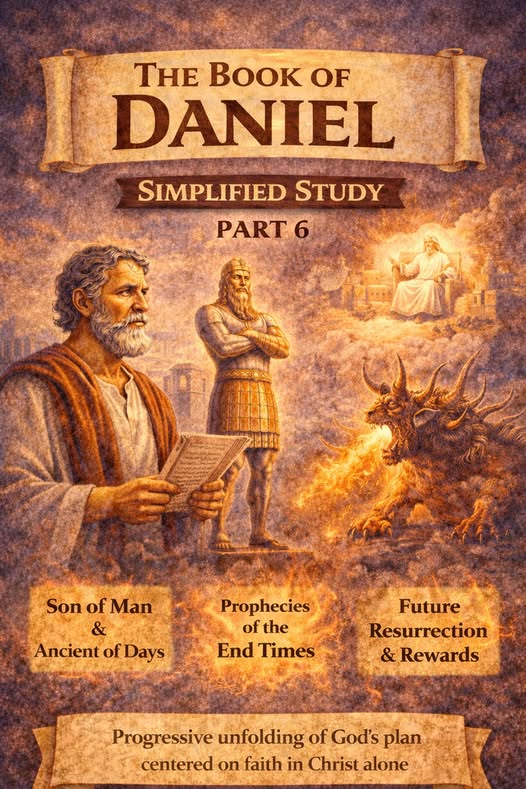
Part 6 of 12
THE SON GIVEN DOMINION AND A KINGDOM
Understanding the coming Kingdom requires rightly dividing Scripture and distinguishing Israel from the Body of Christ.
John the Baptist: Herald of the King
Matthew 3:1-3
• John the Baptist announces the imminent arrival of the Kingdom to Israel.
• Repentance is emphasized because, under the Old Covenant, it was a prerequisite for blessing.
Repentance in context:
• For Israel (metanoeō, Strong’s 3340): A moral reconsideration and change ... morePart 6 of 12
THE SON GIVEN DOMINION AND A KINGDOM
Understanding the coming Kingdom requires rightly dividing Scripture and distinguishing Israel from the Body of Christ.
John the Baptist: Herald of the King
Matthew 3:1-3
• John the Baptist announces the imminent arrival of the Kingdom to Israel.
• Repentance is emphasized because, under the Old Covenant, it was a prerequisite for blessing.
Repentance in context:
• For Israel (metanoeō, Strong’s 3340): A moral reconsideration and change of mind in preparation for God’s Kingdom.
• For us today (metamelomai, Strong’s 3338): Regret or change of direction following salvation; salvation itself is by grace through faith (Ephesians 2:8-9).
Thus, for Israel, repentance precedes the Kingdom. For the Body of Christ, salvation precedes repentance.
Christ’s Identity and the Kingdom
Matthew 16:13-16 – Peter’s Confession
• Jesus asks, “Who do you say I am?”
• Peter responds, “Thou art the Christ, the Son of the living God.”
• This confession recognizes Christ’s messianic identity, not His crucifixion yet. Israel’s acknowledgment was necessary for the Kingdom to be fully realized.
The Promised Kingdom for Israel
Luke 1:67-77 – Zacharias’ prophecy at John the Baptist’s birth:
• God’s promises are reaffirmed for Israel.
• Salvation and deliverance focus on Israel from their enemies and the establishment of a righteous Kingdom.
• John’s role is to prepare Israel for the Messiah, reinforcing that the promises are still primarily for the Jewish people.
Christ’s Ministry and the Kingdom
Acts 1:3-7
• After His resurrection, Jesus spends 40 days teaching about the Kingdom of God.
• The apostles’ questions about the timing of Israel’s Kingdom highlight their expectation of Christ’s return as King.
• Jesus clarifies that the timing is God’s prerogative.
Matthew 19:27-28
• The apostles ask about their reward for following Christ.
• Jesus promises them thrones to rule over the twelve tribes of Israel during the 1,000-year Kingdom (the “regeneration”).
Genesis 15:18 underscores God’s covenantal promise of the land to Abraham’s descendants, forming the territorial basis for Israel’s future governance.
Key Points
1. The Son of Man receives universal dominion (Daniel 7:13-14).
2. Isaiah and Zechariah depict the literal and righteous rule of Christ over a restored earth.
3. Old Testament promises focus on Israel, with the Gentile nations involved as beneficiaries of Israel’s light.
4. John the Baptist and Christ’s ministry emphasized repentance and preparation for Israel’s Kingdom.
5. The apostles understood the Kingdom as an imminent, physical, and national event, not spiritualized for the Church.
6. Salvation by grace through faith and repentance function differently for Israel (repentance first) and the Body of Christ (repentance follows).
This sets the stage for understanding the coming earthly Kingdom, its administration by Christ and the apostles, and the distinction between Israel and the Body of Christ.
Timeline the Old Testament Prophets Saw - Nothing of Paul’s “mysteries”
• Adam – 4004 B.C.
• The Flood – 2348 B.C.
• Babel – 2175 B.C.
• Abraham – 2000 B.C.
• Moses / The Law – 1500 B.C.
• David – 1000 B.C.
• Babylon & Nebuchadnezzar – 606 B.C.
• The Cross (Christ’s death)
• The Ascension – Psalm 110:1
• 7 Years of Tribulation
• Second Coming
• 1,000 Years of the Kingdom
• Eternity
Daniel 7:14–17
Daniel 7:14a
"And there was given him dominion, and glory, and a kingdom, that all people, nations, and languages should serve him; his dominion is an everlasting dominion, which shall not pass away, and his kingdom that which shall not be destroyed."
In this vision, Daniel sees the Son of God being granted authority over a Kingdom that is unlike any human kingdom. When Scripture speaks of a Kingdom, it involves three critical components: a King, a people, and a land. All three are fulfilled in Christ. This Kingdom is not temporary—it is everlasting, impervious to destruction, and beyond human or demonic opposition.
Daniel 7:15
"I Daniel was grieved in my spirit in the midst of my body, and the visions of my head troubled me."
Daniel’s reaction shows us the intensity of revelation. He is human, and even the most spiritually attuned believer can be overwhelmed by the divine unveiling of God's future plans. These visions were not myths or stories; they were supernatural communications from God, revealing His sovereignty and the ultimate triumph of His Kingdom over all earthly powers.
Daniel 7:16
"I came near unto one of them that stood by, and asked him the truth of all this. So he told me, and made me know the interpretation of the things."
Here, Daniel approaches an angel for clarification, showing that God provides understanding alongside revelation. Divine revelation without interpretation can leave even the most faithful grieved or confused.
Daniel 7:17
"These great beasts, which are four, are four kings, which shall arise out of the earth."
The “beasts” represent four successive Gentile empires, each wielding dominion over God’s covenant people in its own time. This imagery should not be read literally; Daniel uses familiar symbols—wild, carnivorous animals—to communicate the power, ferocity, and character of these empires.
1. Lion with eagle’s wings – Babylonian Empire (Daniel 7:4)
o A carnivorous predator, symbolizing Babylon’s swift and ruthless conquests.
2. Bear raised up on one side with three ribs – Medo-Persian Empire (Daniel 7:5)
o The bear’s raised side indicates Persia’s dominance over the Medes, devouring nations (the three ribs).
3. Leopard with four wings – Greek Empire (Daniel 7:6)
o The leopard represents speed and swiftness, reflecting Alexander the Great’s rapid conquests.
o The four wings symbolize the four generals who divided his empire after his death.
4. Dreadful, strong, iron-toothed beast with ten horns – Roman Empire and its end-time revival (Daniel 7:7)
o This empire is different, stronger, and more terrifying, reflecting absolute political and military authority.
o The ten horns correspond to ten kings or nations, foreshadowing the final world government under the Antichrist.
Cross-reference with Daniel 2:
• Nebuchadnezzar’s dream (Daniel 2:31–33) depicts the same four empires as a metallic statue:
o Gold – Babylon
o Silver – Medo-Persia
o Brass – Greece
o Iron and clay – Rome and its future revival
• This shows God’s consistent prophetic pattern and His sovereignty over human history.
Luke 21:20–24 – Jesus confirms this timeline, referring to Jerusalem under Gentile domination until the end of the age. “Times of the Gentiles” refers to periods when Gentile powers rule over Jerusalem, which began with Babylon and continues through history. God’s plan, however, guarantees that His covenant people will ultimately occupy the Promised Land and see the Messiah reign.
Romans 11:25 – The Apostle Paul explains the complementary timeline: while Gentiles experience God’s mercy through the Body of Christ, Israel is temporarily blinded, waiting for the fullness of the Gentiles to be completed. Afterward, God will resume His work with His covenant people.
Daniel 7:18
"But the saints of the most High shall take the kingdom, and possess the kingdom forever, even forever and ever."
This verse leaps to the Millennial Kingdom, when Christ returns to establish His rule, and the saints—both Old Testament believers and tribulation survivors—will share in His reign.
The Fourth Beast and the Antichrist
Scripture: Daniel 7:19–25
Daniel 7:19–20
"Then I would know the truth of the fourth beast… and of the ten horns… even of that horn that had eyes, and a mouth that spake very great things, whose look was more stout than his fellows."
The fourth beast is the end-time revival of the Roman Empire, more dreadful than all previous empires. The ten horns represent ten kings/nations, and one “little horn” rises to power—this is the Antichrist, a charismatic and authoritarian figure empowered by Satan, who will dominate the world and oppose God. Three of the original ten will fall or be subdued, leaving seven under his influence.
Daniel 7:21
"I beheld, and the same horn made war with the saints, and prevailed against them."
The Antichrist will persecute Israel during the great tribulation, successfully killing two-thirds of the Jewish population. Only one-third, God’s preserved remnant, will survive.
Matthew 24:15–21 – Jesus elaborates on these events:
• The “abomination of desolation” signals the Antichrist’s defilement of the rebuilt Temple.
• Jewish believers are instructed to flee to God’s designated place of safety.
• The flight applies to all social classes: the wealthy, the working class, homemakers, and mothers. God will provide supernatural protection, mirroring His faithfulness in the past.
Zechariah 13:8–9
• God will preserve one-third of Israel, refining them like silver and gold.
• This remnant will finally recognize the Messiah, and God will declare them “My people”, a reversal from the historical “thy people.”
Daniel 7:22–25
• The Ancient of Days (God the Father) will intervene, giving judgment and authority to the saints.
• The Antichrist’s rule will end, Israel will enter their Millennial Kingdom, and Christ will reign as King over all the earth.
• The fourth beast represents the final world empire, the stage for the Antichrist.
• The Antichrist arises from this empire, empowered by Satan, to oppose God and persecute Israel.
• God preserves a faithful remnant and ultimately establishes His everlasting Kingdom, fulfilling Daniel’s vision of the Son’s dominion and glory.
Scripture Focus: Daniel 7:14–9:2
Daniel 7:14a
“And there was given him… dominion, and glory, and a kingdom…”
Here, Daniel is describing a vision in which he sees God the Son—Christ—being given authority over an eternal kingdom. Notice carefully: a kingdom involves three essentials: a king, a people, and a land. God is saying that His Son will have all three. His dominion is everlasting, unending, and indestructible.
Daniel 7:14b
“…his dominion is an everlasting dominion, which shall not pass away, and his kingdom that shall not be destroyed.”
This is a kingdom unlike any human government. It cannot fail, cannot be overthrown, and will outlast all earthly empires.
Daniel 7:15
“I, Daniel, was grieved in my spirit in the midst of my body, and the visions of my head troubled me.”
Daniel’s reaction is completely human. Such revelations are overwhelming. Imagine seeing the spiritual realities behind world events, empires rising and falling, and the ultimate triumph of God’s kingdom—no wonder Daniel felt physically troubled.
Daniel 7:16
“I came near unto one of them that stood by, and asked him the truth of all this. So, he told me and made me know the interpretation of the things.”
Daniel turns to an angel for clarity, and God provides interpretation. This shows that God’s prophetic revelation is both mysterious and explainable—we can understand it when He wills.
Daniel 7:17–18
“These great beasts… are four kings that shall arise out of the earth… But the saints of the Most High shall take the kingdom, and possess the kingdom forever.”
The “beasts” represent world empires. Not literal animals, but governments. The final beast—the fourth—is the most terrifying, a picture of the Roman Empire and, ultimately, a revived world empire under the anti-Christ.
• Daniel 7:4 – Lion with eagle’s wings = Babylonian Empire (powerful, predatory).
• Daniel 7:5 – Bear raised on one side = Medo-Persian Empire (conquering with strategic force).
• Daniel 7:6 – Leopard with four wings = Greek Empire under Alexander the Great (fast, expansive conquests, then divided among four generals).
• Daniel 7:7 – Fourth beast, dreadful and strong, with iron teeth and ten horns = Roman Empire (absolute authority, militarily powerful).
Connection to Daniel 2:
The four empires are also seen in Nebuchadnezzar’s dream as a statue of four metals: gold, silver, brass, and iron. Daniel 2 gives the chronological order in another symbolic form, showing God’s consistency in prophecy.
Luke 21:20–24
Jesus spoke prophetically about the desolation of Jerusalem, describing the Roman siege of A.D. 70, which fulfills Daniel’s visions of Gentile dominance. “Times of the Gentiles” refers to the period in which Jerusalem is under foreign control—from Babylon to the British mandate, and even today, with political influence from major powers like the United States.
Romans 11:25
“…that blindness in part is happened to Israel, until the fullness of the Gentiles be come in.”
Paul reveals the mystery of God’s plan: while the world fills its cup of iniquity, God is filling His people, the Body of Christ, who are called out from the Gentiles. Only after this fullness will God resume His direct dealings with Israel in the end times.
Daniel 7:18
“But the saints of the Most High shall take the kingdom, and possess the kingdom forever, even forever and ever.”
This is the ultimate fulfillment of prophecy: after the final Tribulation, Christ will return, defeat evil, and establish His eternal Kingdom, where His saints reign with Him.
THE FINAL EMPIRE AND THE TRIBULATION
Scripture Focus: Daniel 7:18–25; Matthew 24; Zechariah 13
Daniel 7:18a
“But the saints of the Most High shall take the kingdom…”
God’s people—His saints—will inherit the kingdom after the fullness of the Gentiles and the coming Tribulation. This is when Christ Himself will exercise ultimate authority.
Daniel 7:19–20
Daniel seeks understanding about the fourth beast—the final Roman Empire and its ten horns (ten nations). Three of these nations will be conquered or uprooted, leaving seven, over which the singular “little horn” (anti-Christ) will rise. This horn will speak arrogantly against God and oppress the saints.
Daniel 7:21–22
“I beheld, and the same horn made war with the saints, and prevailed against them… until the Ancient of Days came, and judgment was given to the saints of the Most High…”
This is the midpoint of the Tribulation, when the anti-Christ turns against Israel. He will dominate with cunning, charisma, and demonic empowerment. But God preserves a remnant—those He will bring through fiery trial, just as He spared Daniel and his friends in the furnace.
Matthew 24:15–21
Jesus gives practical instructions for Israel during this time: flee to safety when the abomination of desolation occurs in the rebuilt Temple. This remnant will include:
• The wealthy (Matthew 24:17) – leave their possessions behind.
• The working class (Matthew 24:18) – leave quickly, trusting God’s provision.
• Mothers with children (Matthew 24:19–20) – pray for safe timing.
Zechariah 13:8–9
God promises that of Israel, two-thirds will perish, but one-third will survive. This remnant will be refined, purified, and restored as God’s people. They will finally recognize their Messiah, and God will declare, “It is My people,” marking a profound covenantal restoration.
Daniel 7:23–25
The fourth beast (Revised Roman Empire) will be different from all others, devouring and oppressing the world. Out of it, ten kings arise; one will dominate (the anti-Christ), subduing three nations, speaking arrogantly against God, and attempting to alter divine law.
Summary:
• Daniel’s vision spans history—from Babylon to the Tribulation.
• God’s ultimate plan: the defeat of evil, the protection of Israel, and the establishment of Christ’s eternal Kingdom.
• Prophecies interconnect: Daniel, Matthew, Zechariah, Revelation, and Acts all show God’s sovereign orchestration of history.
✠SGT Dinah Scivoletti✠
✠Joan of Arc Priory✠
✠✠Act and God will Act (Actus et Deus Act)✠✠