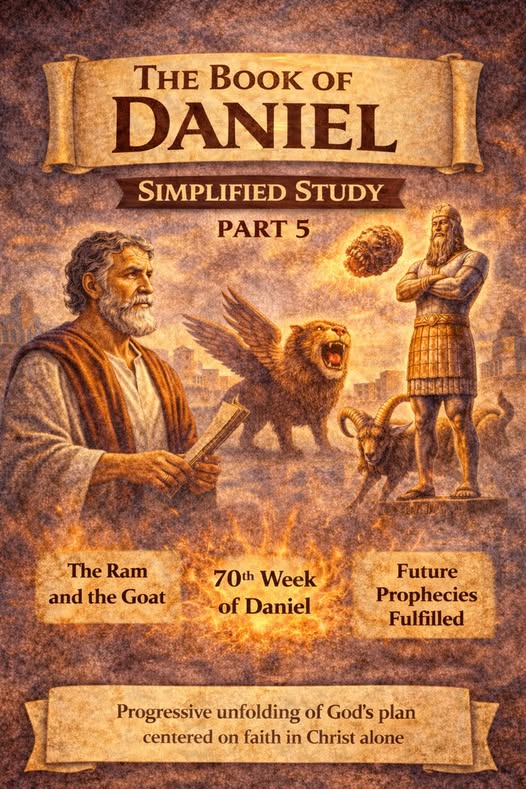
Part 5 of 12
Daniel 7:9–14
“The Vision of the Ancient of Days and the Son of Man”
In Daniel 7, beginning with verse 1, Daniel recounts a vision given to him by God. Unlike Nebuchadnezzar’s dream of a metallic statue (gold, silver, bronze, iron, and clay), Daniel’s prophetic vision portrays the same Gentile empires as living beasts—lion, bear, leopard, and an indescribable fourth beast. Each beast corresponds to the historical succession of empires: Babylon, Medo-Persia, Greece, and Rome.
Th... morePart 5 of 12
Daniel 7:9–14
“The Vision of the Ancient of Days and the Son of Man”
In Daniel 7, beginning with verse 1, Daniel recounts a vision given to him by God. Unlike Nebuchadnezzar’s dream of a metallic statue (gold, silver, bronze, iron, and clay), Daniel’s prophetic vision portrays the same Gentile empires as living beasts—lion, bear, leopard, and an indescribable fourth beast. Each beast corresponds to the historical succession of empires: Babylon, Medo-Persia, Greece, and Rome.
The Accuracy of Prophecy
Skeptics often claim Daniel was a forgery, arguing that he could not have predicted the rise and fall of these empires with such precision unless the account was written after the events. But prophecy is a demonstration of God’s omniscience. As Scripture reminds us, God knows the end from the beginning (Isaiah 46:10). He sovereignly orchestrates human history—including elections, leadership, and world events—while allowing free will to unfold within His divine plan.
Daniel 7:9 – The Ancient of Days
“I beheld until the thrones were cast down, and the Ancient of Days did sit, whose garment was white as snow, and the hair of his head like pure wool; his throne was fiery flames, and its wheels as burning fire.”
Here Daniel shifts from earthly empires to the eternal throne of God the Father. Notice: this is God the Father seated on the throne; God the Son is not described here as seated. The imagery of fiery flames and “wheels” conveys both holiness and divine motion or action.
Heavenly Imagery in Scripture
To understand the “wheels,” consider Ezekiel 1:16:
“The appearance of the wheels and their work was like unto the color of a beryl; they four had one likeness: and their appearance and work was as it were a wheel in the middle of a wheel.”
This otherworldly description parallels the vision in Daniel, showing that the heavenly realm surpasses human comprehension. Revelation 4:2–6 also mirrors this imagery: the throne, the emerald rainbow, twenty-four elders, four living creatures full of eyes—all illustrating the glory and complexity of the heavenly throne room.
Human imagination can grasp only glimpses. Even Paul, when caught up to Heaven, was not allowed to fully describe what he saw (2 Corinthians 12:2–4). The takeaway is simple: God’s glory and Heaven’s majesty are beyond human capacity to fully comprehend.
Daniel 7:10–12 – The Judgment of the Beasts
“A fiery stream issued and came forth from before him; thousand thousands ministered unto him, and ten thousand times ten thousand stood before him: the judgment was set, and the books were opened… I beheld until the beast was slain, and his body destroyed, and given to the burning flame… As concerning the rest of the beasts, they had their dominion taken away, yet their lives were prolonged for a season.”
Here we see the Great White Throne judgment echoed in Revelation 20. The “beast” represents the Antichrist, and his doom is certain: cast into the lake of fire along with the False Prophet (Revelation 19:20). The other nations and powers—these Gentile empires—lose authority but may continue in diminished existence for a time, showing God’s justice and patience.
Daniel 7:13–14 – The Son of Man
“I saw in the night visions, and behold, one like the Son of Man came with the clouds of heaven, and came to the Ancient of Days, and they brought him near before him. And there was given him dominion, and glory, and a kingdom, that all peoples, nations, and languages should serve him: his dominion is an everlasting dominion, which shall not pass away, and his kingdom that which shall not be destroyed.”
Daniel sees the Son of Man—Jesus Christ—approaching the Father, receiving eternal dominion and authority. This parallels Revelation 5:1–13, where Christ, the Lamb, alone is worthy to open the scroll, redeeming mankind by His death, burial, and resurrection. Through this act, God reclaims the dominion over the earth, which was forfeited by Adam’s sin and usurped by Satan.
Key Takeaways:
1. Prophecy validates God’s sovereignty over history.
2. Heaven is incomprehensibly glorious—scriptural imagery helps us glimpse it but cannot capture it fully.
3. The ultimate victory belongs to Christ: the Antichrist and all rebellious powers will be judged.
4. Christ’s resurrection is central; without it, redemption is incomplete.
The Son Given Dominion and a Kingdom
Daniel 7:14 emphasizes that the dominion granted to the Son is both universal and everlasting:
“…his dominion is an everlasting dominion, which shall not pass away, and his kingdom that which shall not be destroyed.”
Many in Christendom fail to grasp that this refers to a literal, earthly Kingdom—a Kingdom ruled by Christ with justice and peace, inhabited by flesh-and-blood humans, yet entirely free from sin and the curse. This is the millennial Kingdom, which ultimately transitions into eternity.
The Kingdom in Revelation and Eternity
Revelation 21:1–5 describes the final renewal:
“Now I saw a new heaven and a new earth… Then I, John, saw the holy city, New Jerusalem, coming down out of heaven… Behold, I MAKE ALL THINGS NEW.” (not new things)
The New Heaven and New Earth reflect God’s ultimate restoration. While believers experience a “new creation” now (2 Corinthians 5:17), the complete transformation awaits eternity. This continuity shows that the millennial Kingdom foreshadows eternal rule, extending Christ’s dominion into a renewed creation.
Old Testament Foundations
The earthly Kingdom is foreshadowed throughout Scripture:
• Exodus 19:3–6: Israel is called to be a “kingdom of priests and a holy nation.” The Kingdom requires a King (Christ), subjects (the people), and territory (promised land).
• Isaiah 9:6–7: Christ is the divine Child whose government and peace will never end, reigning on David’s throne in Jerusalem.
• Isaiah 2:2: The Kingdom of the LORD will be exalted above all other nations, and all nations will ultimately flow unto it.
These passages show the Kingdom is not merely symbolic—it is a tangible, global government under Christ, with Jerusalem as its center, and the authority of the Son of God extending over all creation.
Christ as Communicator
Every divine revelation in Scripture—from Exodus to Daniel to Revelation—demonstrates the role of Christ as the mediator between God the Father and humanity. Hebrews 1:1–2 confirms:
“God…at sundry times and in divers manners spake in time past unto the fathers by the prophets, hath in these last days spoken unto us by his Son.”
This reinforces that Christ is central to the plan of redemption, from prophecy to fulfillment, from judgment to the establishment of His eternal Kingdom.
Summary: Daniel’s vision portrays both earthly empires and heavenly judgment.
• Christ, the Son of Man, receives eternal dominion after the defeat of the Antichrist.
• The millennial Kingdom is literal, global, and sinless, serving as the bridge to eternity.
• Scripture consistently reveals Christ as the divine communicator and ruler.
• Revelation and Old Testament prophecy complement Daniel, showing God’s ultimate plan for Earth and mankind.
THE SON GIVEN DOMINION AND A KINGDOM
Daniel 7:9-14
Let’s continue focusing on the prophecy of the Son of Man, a clear reference to Jesus Christ, and the kingdom given to Him by God.
Daniel 7:13-14a
"I saw in the night visions, and behold, one like the Son of man came with the clouds of heaven, and came to the Ancient of Days, and they brought him near before him. And there was given him dominion, and glory, and a kingdom..."
Here we see a central promise: God gives dominion, glory, and a kingdom to His Son. Notice that this kingdom is not limited to Israel—it is universal. Daniel 7:14b confirms this:
"…that all people, nations, and languages should serve him: his dominion is an everlasting dominion, which shall not pass away, and his kingdom that which shall not be destroyed."
The text gives no explicit duration in the Old Testament, but Revelation later mentions a 1,000-year reign. Importantly, Revelation also points beyond that 1,000 years to the eternal state with a new heaven and a new earth, showing the everlasting nature of Christ’s rule.
The Coming Kingdom in Isaiah
Isaiah 11 provides a prophetic description of Christ’s righteous and universal reign:
Isaiah 11:1-2
"And there shall come forth a rod out of the stem of Jesse, and a Branch shall grow out of his roots: and the Spirit of the LORD shall rest upon him—the Spirit of wisdom and understanding, the Spirit of counsel and might, the Spirit of knowledge and of the fear of the LORD."
This emphasizes that the Messiah will rule with divine wisdom and power, not human limitations.
Isaiah 11:3-5 describes His perfect judgment:
• He will not judge by appearances or partial information.
• He will rule the poor and meek with equity and justice.
• Righteousness and faithfulness will define His governance.
Isaiah 11:6-9 portrays an earth transformed into peace and harmony:
• Predators and prey will coexist peacefully.
• Children will be safe among wild animals.
• Even carnivorous animals will eat plants instead of flesh.
• The earth will be filled with the knowledge of the LORD, reminiscent of the pre-Fall world.
This vision is not symbolic fluff—it is a literal prophecy of a restored creation under Christ’s righteous rule.
The Restoration of Israel in Zechariah
Zechariah 14 outlines the events leading up to Christ’s reign:
Zechariah 14:1-4
• The seven-year Tribulation begins with the gathering of nations against Jerusalem.
• God supernaturally protects the faithful remnant of Israel.
• After these events, the Messiah returns, His feet on the Mount of Olives, separating it and creating a valley.
Zechariah 14:8-9 describes the transformation of the land and Christ’s kingship:
• Rivers of fresh water will flow from Jerusalem, healing the Dead Sea and supporting life.
• The LORD will reign over the whole earth; Israel and the nations will recognize Him as the one true King.
Ezekiel 47 further emphasizes the restoration of nature, with life returning to previously barren areas and an abundance of fish along the riverbanks.
Christ as King in the New Testament
Matthew 5:17
"Think not that I am come to destroy the law, or the prophets: I am not come to destroy, but to fulfil."
Jesus’ earthly ministry fulfilled the Old Testament promises concerning the Kingdom, not primarily the Cross at this stage. His mission was to prepare Israel for His kingship.
Acts 3:18-26 shows Peter preaching to Israel:
• Christ’s suffering and resurrection fulfill Old Testament prophecy.
• Israel is called to repentance in preparation for the “times of refreshing” and the coming Kingdom.
Isaiah 42:1-6 confirms that Israel’s Messiah will also be a light to the Gentiles, but the primary covenantal promises are still focused on Israel.
✠SGT Dinah Scivoletti✠
✠Joan of Arc Priory✠
✠✠Act and God will Act (Actus et Deus Act)✠✠