The Key to Understanding the Bible
The Bible is the greatest book ever given to mankind. Yet, many people hesitate to open its pages because they feel it is a closed door, often saying, “I just can’t understand it.”
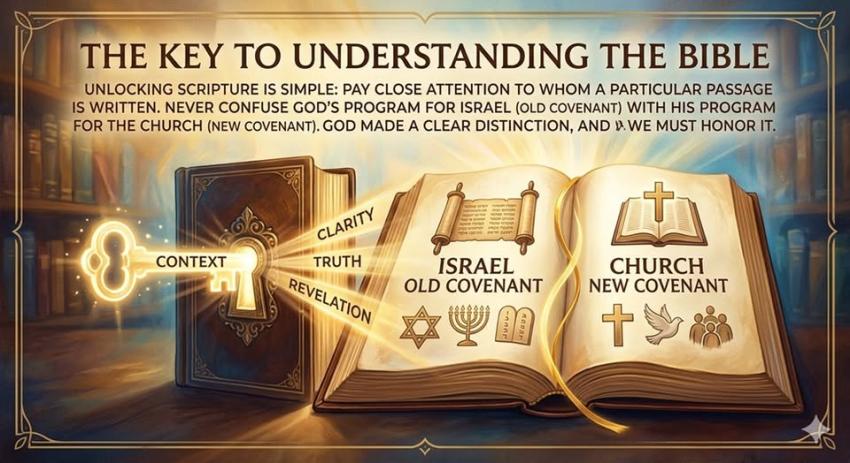
But you can understand it. The key to unlocking the Scriptures is simpler than most realize: YOU MUST PAY CLOSE ATTENTION TO WHOM and from WHOM A PARTICULAR PASSAGE IS WRITTEN. We must never confuse God’s program for Israel (the Old Covenant) with His program for the Church (the Ne... moreThe Key to Understanding the Bible
The Bible is the greatest book ever given to mankind. Yet, many people hesitate to open its pages because they feel it is a closed door, often saying, “I just can’t understand it.”
But you can understand it. The key to unlocking the Scriptures is simpler than most realize: YOU MUST PAY CLOSE ATTENTION TO WHOM and from WHOM A PARTICULAR PASSAGE IS WRITTEN. We must never confuse God’s program for Israel (the Old Covenant) with His program for the Church (the New Covenant). God Himself made a clear distinction between the two, and we must honor that distinction if we are to be faithful students of His Word.
When God speaks to the believer in this present Age of Grace, He primarily does so through the writings of the Apostle Paul. While the entire Bible is written for us, not all of it is written to us as direct command. Many instructions given to Israel under the Old Covenant do not apply to the Church today. However, we must remember that while God’s methods change, His nature does not. The things God hated in ancient Israel, He still hates today. He does not change in His character, holiness, or standards of righteousness (Malachi 3:6). He has simply changed the way He deals with humanity across different periods of history.
The Changing Landscape of Divine Dealings
To understand the Bible, one must recognize how God’s dealings have shifted through time. These are not changes in God’s mind, but transitions in His administrative plan for the earth.
In the Garden of Eden Adam and Eve lived in perfect, unhindered fellowship with their Creator. There was no sin, no curse, and no death. They enjoyed daily communion in a world of perfection.
After the Fall Everything changed instantly. Sin entered the world, the curse followed, and humanity was expelled from the garden. Life was now defined by toil, pain, spiritual separation, and physical death (Genesis 3).
After the Flood Humanity grew so corrupt that God destroyed the world, sparing only Noah and his family. When they stepped off the ark, the world operated under a new set of conditions—different from Eden and different from the pre-flood world (Genesis 9).
After the Tower of Babel When humanity rebelled again, God responded by confusing their languages and scattering the nations across the earth. This marked another major shift in how God governed the human race.
The Call of Abraham God began something entirely new: a covenant relationship with one chosen nation, Israel. Through this people, He would reveal His purposes and ultimately bring forth the Messiah (Genesis 12:1-3).
The Law of Moses Around 1500 BC, God gave Israel the Law—a system that was strict, precise, and unforgiving. To break the Law was to invite death. Picking up sticks on the Sabbath or committing adultery brought swift judgment. This was Law in its purest form, not the watered-down traditions often seen today.
The Dispensation of Grace Then came the Apostle Paul, through whom God revealed a mystery never before seen: the message that we are "not under law but under grace" (Romans 6:14). To Israel, this was shocking. Grace represents an entirely different set of conditions—a new way God deals with mankind based on the finished work of Jesus Christ.
Why Distinctions Matter
The Bible is not inherently difficult to understand; the difficulty arises when people mix things that God has kept separate. CONFUSION IS THE NATURAL RESULT OF BLENDING LAW AND GRACE, OR ISRAEL AND THE CHURCH.
The Apostle Paul’s writings—Romans through Philemon—contain the doctrine, instruction, and revelation specifically for the Church, which is the Body of Christ. This section of Scripture is where every believer should begin, as it explains salvation by faith alone, our position in Christ, and our hope for the future. As Paul writes in 1 Corinthians 15:1–4, the gospel for today is built upon the death, burial, and resurrection of Christ.
Even books like Hebrews, while containing profound truth, must be placed in their proper context. Hebrews was written to Jewish believers who had come to Christ through the "gospel of the kingdom." It is not addressed to the Gentile-led Body of Christ in the same way Paul's prison epistles are. When we "rightly divide" these sections, the Bible moves from a book of contradictions to a masterpiece of divine order.
The Science of Interpretation: Exegesis and Hermeneutics
To arrive at the truth, we must practice Exegesis—the careful, critical explanation of a text. True exegesis seeks to draw out the meaning the author intended, rather than reading our own ideas into the verses. This requires us to divide the Word carefully: dispensationally, prophetically, and historically.
Supporting this is Hermeneutics, the study of the rules and methods used to interpret the Bible. Every believer is commanded to be a practitioner of hermeneutics. As 2 Timothy 2:15 charges us:
"Do your best to present yourself to God as one approved... rightly dividing the word of truth."
The Laws of Understanding
1. The Law of Literal Interpretation: We interpret the Bible in its normal, natural, plain sense. If Jesus says He fed five thousand (Mark 8:19), we believe five thousand real people were fed. We do not "spiritualize" or search for "secret" meanings that bypass the plain text.
2. The Law of Context: We must interpret historically (understanding the culture of the time), grammatically (following the rules of language), and contextually (looking at the surrounding verses and the book as a whole). For example, the "meaningless" outlook in Ecclesiastes is understood only when we see the phrase "under the sun," which defines the book's earthly perspective.
3. The Law of Scriptural Harmony: The Bible never contradicts itself. Therefore, we compare Scripture with Scripture. Isaiah’s condemnation of trusting in Egyptian horses (Isaiah 31:1) is understood perfectly when compared to God's earlier command in Deuteronomy 17:16.
Hermeneutics is not about restricting the Holy Spirit; it is about protecting God’s truth from personal bias and tradition. As Jesus prayed in John 17:17, "Sanctify them through Thy truth; Thy Word is truth." To walk in that truth, we must be faithful interpreters of the Word.
✠SGT Dinah Scivoletti✠
✠Joan of Arc Priory✠
✠✠Act and God will Act (Actus et Deus Act)✠✠