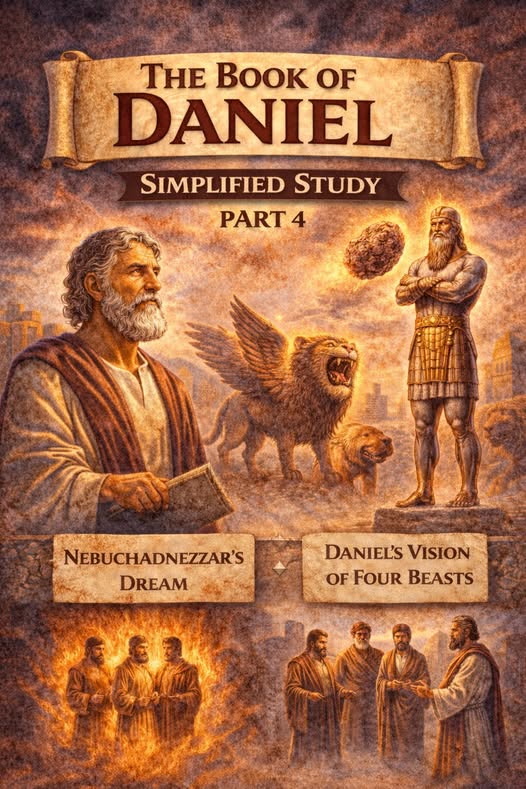
Part 4 of 12
The Handwriting on the Wall
Text: Daniel 5:1 – 6:2
Belshazzar, the grandson of Nebuchadnezzar, ruled Babylon during its final days. Though he inherited one of the greatest empires in history, he lacked the humility his grandfather eventually learned.
One night, Belshazzar held a great banquet for a thousand of his nobles. During the feast, he committed an act of shocking irreverence.
He ordered that the sacred vessels taken from the Temple in Jerusalem be brought in, and he and... morePart 4 of 12
The Handwriting on the Wall
Text: Daniel 5:1 – 6:2
Belshazzar, the grandson of Nebuchadnezzar, ruled Babylon during its final days. Though he inherited one of the greatest empires in history, he lacked the humility his grandfather eventually learned.
One night, Belshazzar held a great banquet for a thousand of his nobles. During the feast, he committed an act of shocking irreverence.
He ordered that the sacred vessels taken from the Temple in Jerusalem be brought in, and he and his guests drank wine from them.
These vessels had been set apart for God’s service. They were holy—not because of their material, but because of their purpose.
Yet Belshazzar used them to praise idols:
“They drank wine, and praised the gods of gold, and of silver, of brass, of iron, of wood, and of stone.” (Daniel 5:4)
These idols represented human invention and religious corruption. They had no life, no power, and no authority.
Belshazzar was openly defying the God of heaven.
The Hand Appears
Suddenly, in the midst of the feast, a supernatural event occurred.
A hand appeared and began writing on the palace wall.
The king saw it.
Immediately, his confidence vanished. His face turned pale. His knees trembled.
He called his wise men, astrologers, and soothsayers—but none could interpret the message.
Human wisdom failed completely.
Daniel Is Summoned
At last, the queen remembered Daniel—the man whom Nebuchadnezzar had trusted.
Though now an elderly man, Daniel was brought before the king.
Belshazzar offered him wealth and power if he could interpret the writing.
Daniel refused the rewards but agreed to give the interpretation.
Before explaining the message, Daniel reminded Belshazzar of his grandfather’s experience.
Nebuchadnezzar had been humbled by God.
He had learned that God rules over all.
Belshazzar knew this history.
Yet he had ignored it.
Daniel declared:
“Thou… hast not humbled thine heart, though thou knewest all this.” (Daniel 5:22)
This was his great sin—not ignorance, but willful rejection.
The Meaning of the Writing
The message written on the wall was:
MENE, MENE, TEKEL, UPHARSIN
Daniel explained:
MENE — God has numbered your kingdom and finished it.
TEKEL — You have been weighed in the balances and found wanting.
PERES — Your kingdom is divided and given to the Medes and Persians.
This was not a warning.
It was a verdict.
Babylon’s time had ended.
Babylon Falls
That very night, the prophecy was fulfilled.
The Medo-Persian army diverted the Euphrates River, allowing soldiers to enter the city through the dry riverbed beneath the walls.
Babylon fell suddenly and unexpectedly.
Belshazzar was killed.
The Medo-Persian Empire took control, under the leadership of Darius the Mede.
Daniel Preserved Through Changing Empires
Though kingdoms fell, Daniel remained.
He continued to serve under the new government.
This demonstrates an important truth:
God preserves His servants even as world empires rise and fall.
Daniel had served under Babylon.
He would now serve under the Medes and Persians.
And he would continue to play a vital role in God’s unfolding prophetic plan.
Key Lessons
1. God rules over all human authority.
2. Pride leads to humiliation.
3. God gives opportunity for repentance.
4. Judgment comes when God’s warnings are ignored.
5. Earthly kingdoms are temporary.
6. God’s kingdom is eternal.
Faith in the Midst of Opposition
Scripture Reference: Daniel 4:26 – 7:8
As we continue through the Book of Daniel, we see a profound pattern: God blesses those who walk faithfully in His ways, even in the midst of worldly opposition. Daniel, a man of unwavering faith and integrity, had received extraordinary wisdom, understanding, and insight from God. Yet this very integrity made him a target.
The world often cannot tolerate a person of such character. Even today, those who stand firm in their convictions, especially faith-based convictions, often face attacks, criticism, or political resistance. Daniel faced a similar reality: he did not compromise or hide his devotion to God.
Daniel’s Unshakable Devotion
Daniel 6:9-10 shows his response to a decree that threatened his life:
“Now when Daniel knew that the writing was signed, he went into his house; and his windows being open toward Jerusalem, he kneeled upon his knees three times a day, and prayed, and gave thanks before his God, as he did aforetime.”
The decree did not alter Daniel’s devotion. He continued his practice of prayer, openly and faithfully.
When his adversaries—the 120 satraps and the two presidents—discovered Daniel praying, they brought this to King Darius’ attention:
“Hast thou not signed a decree, that every man that shall ask a petition of any God or man within thirty days, save of thee, O king, shall be cast into the den of lions?” (Daniel 6:12b)
Darius, though trapped by the law of the Medes and Persians which could not be altered (Daniel 6:15), deeply respected Daniel. His initial response was frustration with himself, as he tried everything legally possible to save Daniel (Daniel 6:14b).
Divine Deliverance
Daniel was cast into the lions’ den, but God intervened:
“My God hath sent his angel, and hath shut the lions’ mouths, that they have not hurt me…” (Daniel 6:22)
Daniel’s faithfulness brought about God’s miraculous deliverance. His life is a testimony that integrity and devotion to God result in divine protection and honor. Consequently, those who had sought Daniel’s destruction were themselves cast into the den (Daniel 6:24), illustrating divine justice.
Gentiles Who Recognized the God of Israel
God’s sovereignty extends beyond Israel. Just as Jethro, Moses’ father-in-law, acknowledged the God of Israel (Exodus 18:1-12), Gentile leaders like Darius came to recognize the living God. Daniel 6:26-28 underscores this universal acknowledgment:
“…men tremble and fear before the God of Daniel: for He is the living God, and steadfast for ever, and his kingdom which shall not be destroyed.”
Prophetic Vision of Future Empires
Daniel 7 presents a vision of the future Gentile empires as beasts arising from the “great sea of humanity”:
1. Lion with eagle’s wings – Babylon (Daniel 7:4)
2. Bear with three ribs in its mouth – Medo-Persia (Daniel 7:5)
3. Leopard with four wings and four heads – Greece under Alexander the Great (Daniel 7:6)
4. Dreadful fourth beast with ten horns – Rome, extending into the revived end-time empire (Daniel 7:7-8)
The “little horn” emerging from the ten horns represents the future anti-Christ, a charismatic yet wicked ruler (Daniel 7:8; 11:21). His characteristics align with the descriptions in II Thessalonians 2 and Revelation 13: a human empowered by Satan, who will deceive the nations and oppose God.
The Coming Anti-Christ and End-Time Prophecy
Scripture References: Daniel 7:8; II Thessalonians 2:3-4; Revelation 13
When studying prophecy, it’s common to encounter differing interpretations. Some focus on minor details rather than the overarching message. Our aim is to see the big picture: the rise of the anti-Christ and the end-time events.
The Anti-Christ and the Revived Roman Empire
Daniel 7:8 describes the “little horn” rising among ten horns, representing ten nations within a revived/revised Roman Empire. Three of these nations will be subdued or eliminated, giving rise to the anti-Christ as a dominant global figure:
“…before whom there were three of the first horns plucked up by the roots; and, behold, in this horn were eyes like the eyes of man, and a mouth speaking great things.”
This future world ruler will be brilliant, manipulative, and highly persuasive, drawing the world to him through charisma and deception.
Paul’s Prophecy: II Thessalonians 2
The apostle Paul emphasizes that the anti-Christ cannot be revealed until the “falling away” occurs:
“…that man of sin…be revealed, the son of perdition, Who opposeth and exalteth himself above all that is called God…” (II Thessalonians 2:3-4)
He will even set himself up in a reconstructed Temple in Jerusalem, claiming divine authority.
Revelation 13: The Anti-Christ and His Empire
John the Revelator provides further insight:
• The anti-Christ rises from the “sea of humanity,” symbolizing global influence.
• He receives power from Satan (Revelation 13:2).
• A deadly wound to one of his heads is healed, astounding the world (Revelation 13:3).
• He speaks blasphemies and rules for forty-two months (three-and-a-half years), the midpoint of the Tribulation (Revelation 13:5-6).
• He will dominate nations, languages, and people, exercising unprecedented control (Revelation 13:7-8).
The Role of Satan
At the midpoint of the Tribulation, Satan is cast from heaven to earth (Revelation 12:7-9), fully empowering the anti-Christ. This is reminiscent of Job 1:6-8, where Satan had access to the heavenly council. Now, he is cast down with his angels, seeking vengeance in a short window of three-and-a-half years.
The False Prophet
The anti-Christ will have a religious counterpart, the False Prophet, described in Revelation 19:20. Together, they will deceive the world and enforce worship of the beast system until Christ’s return.
Key Insight
While understanding end-time prophecy is important, it is secondary to our calling in Christ. The Rapture removes the Church before the Tribulation, ending the current age of grace. Believers must focus on faithfulness, prayer, and living under God’s guidance, rather than becoming overly preoccupied with the minutiae of the seven-year Tribulation.
Expanded Reflection
1. Faith Over Fear: Daniel’s story demonstrates that unwavering faith and devotion to God can overcome worldly threats.
2. Gentiles Recognizing God: God’s sovereignty is universal, drawing even foreign rulers to acknowledge His power.
3. Prophetic Continuity: Daniel, Paul, and John provide a unified prophetic vision of the end-time empire and the rise of the anti-Christ.
4. The Church and Grace: The Rapture signifies the end of this age of grace; understanding prophecy should encourage preparedness and spiritual focus, not fear.
✠SGT Dinah Scivoletti✠
✠Joan of Arc Priory✠
✠✠Act and God will Act (Actus et Deus Act)✠✠