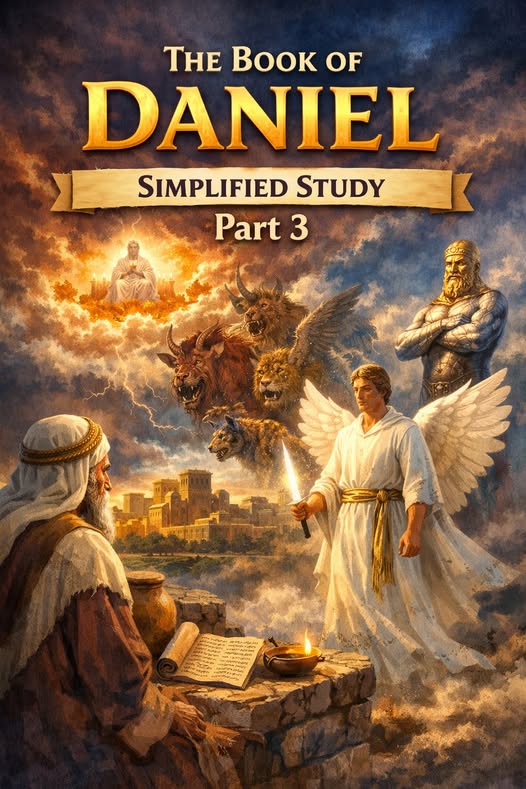
Part 3 of 12
Daniel 3 — The Image, the Furnace, and the Faithful Remnant
As we move into Daniel chapter 3, we leave the prophetic panorama of chapter 2 and enter a historical event that carries profound prophetic implications.
Nebuchadnezzar erects a massive image on the plain of Dura in the province of Babylon. The structure is staggering in scale — sixty cubits high and six cubits wide (approximately ninety feet tall). It dominates the landscape. It is meant to command attention. It is mean... morePart 3 of 12
Daniel 3 — The Image, the Furnace, and the Faithful Remnant
As we move into Daniel chapter 3, we leave the prophetic panorama of chapter 2 and enter a historical event that carries profound prophetic implications.
Nebuchadnezzar erects a massive image on the plain of Dura in the province of Babylon. The structure is staggering in scale — sixty cubits high and six cubits wide (approximately ninety feet tall). It dominates the landscape. It is meant to command attention. It is meant to demand submission.
And submission is exactly what the decree requires.
“Whoso falleth not down and worshippeth shall the same hour be cast into the midst of a burning fiery furnace.” (Daniel 3:6)
This is not optional allegiance. It is enforced worship.
Global Representation — Unified Political Submission
When the music sounds — the orchestra of state power — “all the people, the nations, and the languages” fall down and worship.
This does not necessarily mean every individual on earth stood there physically. Rather, representatives from across the empire were present — government officials, rulers, dignitaries — much like global representation at major state ceremonies today. What is pictured is international political unity under one image.
It is centralized authority.
It is coerced worship.
It is political religion.
The scene foreshadows what will later be revealed in Revelation 13 — a global system requiring allegiance under threat of death.
Why Was Israel in Babylon?
We must remember why these Jewish exiles are even present in Babylon.
There were two major reasons for the seventy-year captivity:
1. The Neglected Sabbatical Years
According to Leviticus 25, Israel was to let the land rest every seventh year. For 490 years they ignored this command. God allowed the land to enjoy its missed Sabbaths through seventy years of desolation (cf. 2 Chronicles 36:21).
2. Idolatry and Moral Corruption
Far more serious was Israel’s descent into pagan worship. Despite repeated warnings in Deuteronomy 7, they adopted the abominations of the surrounding nations.
By the time of Jeremiah, they were openly worshiping the “Queen of Heaven” (Jeremiah 44) — a title connected with pagan fertility goddesses such as Astarte, Diana, and Athena. This worship was not harmless ritual. It was intertwined with gross immorality.
God’s judgment was not arbitrary. It was a response to covenant violation and spiritual corruption.
So, when Shadrach, Meshach, and Abednego refuse to bow, they are not merely resisting political authority — they are rejecting the very idolatry that had previously brought national judgment.
The Accusation
Certain Chaldeans — the elite magian class of Babylon — accuse the Jews. Their resentment is fueled not only by religious difference but by jealousy. These Jewish young men occupy high governmental positions.
Nebuchadnezzar confronts them personally:
“Who is that God that shall deliver you out of my hands?”
This is the language of pride. It is the voice of human sovereignty challenging divine authority.
History repeatedly produces leaders who believe themselves untouchable. Yet Scripture consistently reminds us: “The Most High ruleth in the kingdom of men” (Daniel 4:17).
The Faith of the Three
Their answer is one of the most powerful declarations of faith in Scripture:
“Our God whom we serve is able to deliver us… But if not… we will not serve thy gods.”
Notice the balance:
• Confidence in God’s power.
• Submission to God’s will.
• Refusal to compromise.
They do not presume deliverance.
They do not negotiate obedience.
They remain faithful regardless of outcome.
The Furnace — A Prophetic Picture
The furnace is heated seven times hotter — an image of intensified wrath.
Prophetically, this event previews Israel’s future tribulation. In Matthew 24, the Lord Jesus speaks of a coming “great tribulation” unparalleled in history. He references “the abomination of desolation, spoken of by Daniel the prophet.”
Just as Nebuchadnezzar’s image demanded worship, so will the coming world ruler (described in Revelation 13) enforce global allegiance.
But just as three were preserved in the fire, a remnant of Israel will be divinely protected.
Revelation 12 describes Israel (symbolized as a woman) fleeing into the wilderness, nourished and preserved for three and a half years. The dragon’s attempt to destroy her fails. God intervenes.
The furnace becomes a prophetic template:
• Persecution
• Divine preservation
• Visible vindication
The Fourth Man in the Fire
Nebuchadnezzar sees four men walking loose in the flames.
“The form of the fourth is like the Son of God.”
The pre-incarnate Christ identifies Himself with His faithful servants in their trial.
The fire that kills the soldiers does not harm the bound believers.
They enter bound.
They walk free.
The only thing burned is their bondage.
This is not merely miracle — it is theology in narrative form.
Daniel 3:26 – 4:25 — The Humbling of a King
Nebuchadnezzar approaches the furnace and calls them out:
“Ye servants of the most high God…”
This title is significant. He does not yet fully understand covenant revelation, but he acknowledges supremacy.
They emerge untouched:
• No burns.
• No scorched garments.
• No smell of smoke.
The miracle is absolute.
Nebuchadnezzar responds with a decree honoring their God. Yet his reaction still reveals instability — he swings from forced idolatry to forced reverence. Human authority without spiritual transformation remains volatile.
The Most High vs. Jehovah
It is worth noting the progression of divine titles.
In Genesis 14, God is called “the Most High” (El Elyon) — a title emphasizing universal sovereignty.
In Exodus 6:3, God reveals Himself to Israel as Jehovah (YHWH), the covenant name.
Nebuchadnezzar recognizes God’s supremacy but does not yet grasp covenant intimacy. He acknowledges power — not relationship.
Another Dream — The Tree
In Daniel 4, Nebuchadnezzar dreams again.
He sees a massive tree:
• Reaching to heaven.
• Visible to the whole earth.
• Providing shelter and sustenance.
The tree represents his kingdom — expansive, prosperous, dominant.
But a “watcher” from heaven decrees:
Cut it down.
Leave the stump bound with iron and brass.
The imagery echoes the metallic succession of Daniel 2. Empires will continue, but this ruler will be humbled.
The Judgment: Seven Times
Daniel interprets:
The king will be driven from men.
He will dwell like an animal.
Seven times (likely years) will pass over him.
Why?
“Till thou know that the most High ruleth in the kingdom of men.”
This is the theological center of Daniel.
Empires rise — by God.
Rulers fall — by God.
Authority is delegated — never autonomous.
Nebuchadnezzar’s insanity will not be political accident; it will be divine discipline.
Sovereignty Over History
Daniel presents a worldview the modern mind resists:
History is not random.
Power is not self-generated.
Global systems move within divine permission.
From Babylon to Medo-Persia, from Greece to Rome, from ancient empires to future confederations — the Most High governs the timeline.
The coming world ruler described prophetically will not arise outside God’s knowledge. Even global consolidation — political, economic, religious — unfolds within sovereign design.
God is never late.
God is never surprised.
God is never overruled.
The Lesson
Nebuchadnezzar will be reduced to beast-like existence until he learns humility.
The message is clear:
Pride precedes humiliation.
Sovereignty belongs to God.
Deliverance belongs to God.
Kingdoms belong to God.
And whether in a furnace or a palace, the Most High rules.
The Humbling and Restoration of Nebuchadnezzar
Text: Daniel 4:26 – 5:4
We now continue examining the remarkable dream given to Nebuchadnezzar, the king of Babylon. This dream concerned a great tree—immense in size, visible to the ends of the earth. Its branches provided shelter for beasts, its leaves gave covering, and its fruit sustained both animals and man (Daniel 4:10–12). It symbolized Nebuchadnezzar himself and the vast kingdom over which he ruled.
Once again, God appointed His servant Daniel to interpret the dream.
Daniel began by declaring:
“This is the interpretation, O king, and this is the decree of the most High…” (Daniel 4:24)
Notice the title used here—“the most High.” This designation is used frequently in Daniel because the book largely deals with Gentile kingdoms. Israel knew God by His covenant name, Jehovah—the LORD, the God of Abraham, Isaac, and Jacob. But to the Gentile world, He is revealed as the Most High God, the One who rules over all nations, whether they acknowledge Him or not.
This truth is central to the interpretation of Nebuchadnezzar’s dream.
God’s Sovereignty Over Kings
Daniel revealed that Nebuchadnezzar would be removed from his throne and driven from human society:
“They shall drive thee from men… and seven times shall pass over thee, till thou know that the most High ruleth in the kingdom of men, and giveth it to whomsoever he will.” (Daniel 4:25)
These “seven times” refer to seven years. For seven years, the greatest king on earth would live like a wild animal. He would eat grass like an ox, live exposed to the elements, and lose his sanity.
Why?
To teach him—and all humanity—a vital truth:
God alone rules over the kingdoms of men.
This principle is reinforced in the New Testament. The Apostle Paul the Apostle wrote:
“There is no power but of God: the powers that be are ordained of God.” (Romans 13:1)
This means no ruler rises to power apart from God’s sovereign permission. Even rulers who oppose God ultimately serve His purposes.
History confirms this repeatedly. Kingdoms rise and fall, but God remains in control.
The Stump: A Promise of Restoration
Daniel also explained that the tree’s stump would remain:
“Thy kingdom shall be sure unto thee, after that thou shalt have known that the heavens do rule.” (Daniel 4:26)
This was a promise of restoration. Nebuchadnezzar’s kingdom would not be permanently taken away. Instead, his authority would be preserved until he learned humility.
The bands of iron and brass around the stump symbolized restraint and preservation. His kingdom would continue, but he himself would be humbled.
This imagery also reflects a broader historical truth. Though Babylon would eventually fall, its influence would continue through successive empires—the Medo-Persian, Greek, and Roman empires. These Gentile powers would shape world history and play key roles in God’s prophetic program.
Even today, the regions of ancient Medo-Persian remain central to world events.
Daniel’s Call to Repentance
Daniel did not merely interpret the dream—he urged the king to repent:
“Break off thy sins by righteousness, and thine iniquities by shewing mercy to the poor…” (Daniel 4:27)
This shows God’s mercy. Judgment was not immediate. Nebuchadnezzar was given opportunity to humble himself voluntarily.
But pride is difficult for fallen man to surrender.
For twelve months, nothing happened. Life continued as usual.
Then one day, walking upon the palace roof and gazing over his magnificent capital, Nebuchadnezzar declared:
“Is not this great Babylon, that I have built… by the might of my power, and for the honour of my majesty?” (Daniel 4:30)
His words revealed the condition of his heart—self-exaltation. He gave no glory to God.
God’s Judgment Falls
Immediately, God spoke from heaven:
“O king Nebuchadnezzar, to thee it is spoken; The kingdom is departed from thee.” (Daniel 4:31)
At that very moment, the judgment was fulfilled.
Nebuchadnezzar lost his sanity and was driven from men. For seven years he lived like an animal—his hair grew long and matted, and his nails became like claws.
The greatest king on earth became lower than the lowest servant.
This dramatic humbling demonstrates God’s absolute authority over human pride.
Nebuchadnezzar’s Restoration and Confession
After seven years, Nebuchadnezzar lifted his eyes toward heaven:
“Mine understanding returned unto me, and I blessed the most High…” (Daniel 4:34)
He acknowledged God’s eternal sovereignty:
“His dominion is an everlasting dominion… and none can stay his hand.” (Daniel 4:34–35)
His sanity was restored. His kingdom was restored. His authority was restored.
But most importantly, his perspective was transformed.
He concluded:
“Those that walk in pride he is able to abase.” (Daniel 4:37)
Nebuchadnezzar had learned the lesson God intended.
He began as a proud pagan ruler. He ended as a man who acknowledged the God of heaven.
Transition to the Next Generation
Time passes. Nebuchadnezzar dies. His dynasty continues through his descendants.
As foretold by the prophet Jeremiah, Babylon would remain powerful through his son and grandson (Jeremiah 27:6–7).
Now we move to the reign of his grandson, Belshazzar.
Unlike Nebuchadnezzar, Belshazzar did not learn from the past.
He would repeat the same fatal mistake—pride and disregard for the Most High God.
✠SGT Dinah Scivoletti✠
✠Joan of Arc Priory✠
✠✠Act and God will Act (Actus et Deus Act)✠✠