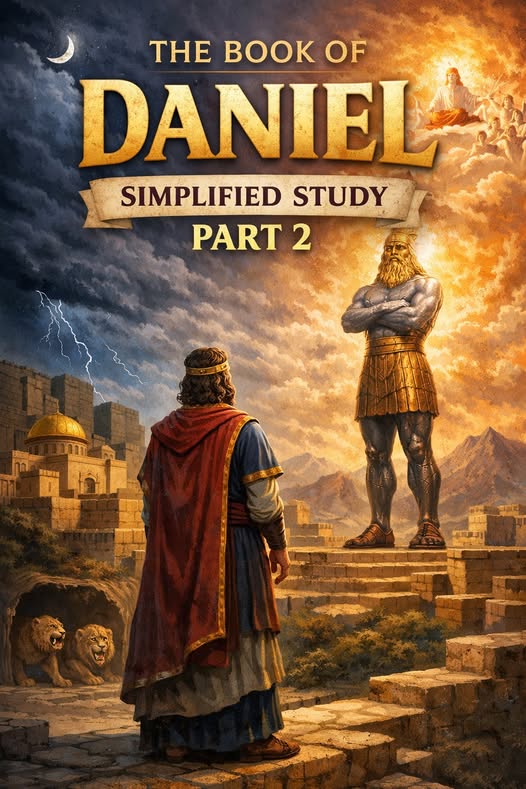
Part 2 of 12
Daniel 2:31–39 — The Image of the Gentile Empires
Daniel now recounts the dream.
The Great Image
Nebuchadnezzar saw a massive, dazzling, terrifying image — the likeness of a man.
Its composition:
• Head of gold
• Chest and arms of silver
• Belly and thighs of brass
• Legs of iron
• Feet of iron mixed with clay
Even the metals preach.
Gold is heaviest and most precious.
Each succeeding metal decreases in value and density.
The image is top-heavy.
That is exactly how Ge... morePart 2 of 12
Daniel 2:31–39 — The Image of the Gentile Empires
Daniel now recounts the dream.
The Great Image
Nebuchadnezzar saw a massive, dazzling, terrifying image — the likeness of a man.
Its composition:
• Head of gold
• Chest and arms of silver
• Belly and thighs of brass
• Legs of iron
• Feet of iron mixed with clay
Even the metals preach.
Gold is heaviest and most precious.
Each succeeding metal decreases in value and density.
The image is top-heavy.
That is exactly how Gentile political power would unfold — increasingly broad, increasingly divided, increasingly unstable.
The Stone Without Hands
Then something dramatic occurs:
“A stone was cut out without hands…”
Not formed by human effort.
This Stone strikes the image at its feet — the weakest point — and shatters it completely.
Throughout Scripture, the Stone represents Jesus Christ:
• The smitten Rock in Exodus
• The Chief Cornerstone
• The rejected Stone
• The Head of the corner
This will be the Second Coming.
Christ does not reform the kingdoms of men.
He destroys them.
The entire statue — gold, silver, brass, iron — becomes like chaff blown away.
Then the Stone becomes a great mountain and fills the whole earth.
That is the Kingdom of God.
Identifying the Empires
Daniel interprets plainly:
“Thou art this head of gold.”
Babylon under Nebuchadnezzar is the first great Gentile world empire.
After Babylon:
1. Medo-Persia — silver
2. Greece — brass
3. Rome — iron
4. A divided final form — iron mixed with clay
History confirms the sequence precisely.
What is remarkable is that this prophecy was given before Medo-Persia rose, before Alexander the Great, before Rome.
God revealed the timeline centuries in advance.
The Decline of Political Unity
Daniel says the next kingdom would be “inferior.”
Not militarily — but politically.
Babylon was absolute monarchy.
Medo-Persia was dual authority.
Greece fragmented after Alexander.
Rome eventually divided.
Each empire became more complex, more distributed, more unstable.
The metals descend in value.
Power broadens — unity weakens.
This progression culminates in the final mixed kingdom symbolized by iron and clay — strong yet brittle.
The Westward Movement
From Babylon westward, civilization shifted progressively:
• Babylon
• Persia
• Greece
• Rome
The major thrust of biblical and church history moved west.
In Acts 16, when Paul sought to turn eastward, the Holy Spirit forbade him and gave the Macedonian vision.
Christianity crossed into Europe.
Western civilization was profoundly shaped by the gospel.
This was not accidental geography.
It was divine design.
God’s Foreknowledge
Acts 2:23 reminds us:
Christ was delivered by “the determinate counsel and foreknowledge of God.”
Nothing in history surprises God.
The same God who revealed the empires to Daniel had already foreordained the cross.
The same God governs present-day nations.
He removes kings.
He sets up kings.
And when the appointed time comes, the Stone will strike.
Daniel 2:40–49 — The Fourth Kingdom and the Times of the Gentiles
As we continue in Daniel 2, I do not expect everyone to agree on every point. But I do encourage this: search the Scriptures. That is our responsibility (John 5:39; 2 Timothy 2:15). Let the text speak.
We have already seen the progression of Nebuchadnezzar’s dream:
• Head of gold — Babylon
• Chest and arms of silver — Medo-Persia
• Belly and thighs of brass — Greece
• Legs of iron — Rome
• Feet and toes of iron mixed with clay — a divided, final phase
There is a downward progression in political unity, yet an upward progression in military strength.
The Fourth Kingdom — Iron
Daniel 2:40 describes the fourth kingdom as “strong as iron.” Historically, this clearly aligns with the Roman Empire — the most formidable military machine of the ancient world. Rome crushed opposition with efficiency and authority. The iron legions subdued territories geographically, politically, and economically.
Rome was unlike Babylon’s centralized monarchy. It was a republic with a senate. Authority was distributed. Politically, the unity weakened compared to Babylon’s absolute dictatorship — yet militarily, Rome surpassed all prior empires.
Political structure weakens as you descend the image. Military strength increases.
The Feet and Toes — Iron Mixed with Clay
Daniel 2:41–43 introduces something new: iron mixed with clay.
This mixture does not bond. Clay and iron do not adhere. The result is fragile unity.
The text says:
“They shall mingle themselves with the seed of men: but they shall not cleave one to another.”
This speaks of diversity without cohesion — strength mixed with instability.
Many see this as the final phase of the Roman system — a revived or revised form. The geography corresponds largely to the territory of ancient Rome. After World War II, European consolidation began, eventually forming what we now know as the European Union.
It is a coalition. It is structured. Yet it is divided.
Partly strong. Partly brittle.
The statue shows a final ten-toed phase — a confederated structure. Out of that final arrangement, Scripture indicates a ruler will arise — the one commonly called the Antichrist (cf. Daniel 7; Revelation 13).
“In the Days of These Kings…”
Daniel 2:44 shifts from human empires to divine intervention.
“And in the days of these kings shall the God of heaven set up a kingdom, which shall never be destroyed…”
Notice the timing: during the final phase — not after centuries, but in the days of those kings.
The stone cut without hands strikes the image at the feet — the final stage — and the entire statue collapses.
Gold, silver, brass, iron — all reduced to dust.
The stone represents the Messiah — the Lord Jesus Christ — whose kingdom replaces all human rule.
Unlike every prior empire, this kingdom:
• Will not be inherited by another people
• Will not weaken over time
• Will not collapse
• Will stand forever
The Times of the Gentiles
Now turn to Luke 21.
Jesus declared:
“Jerusalem shall be trodden down of the Gentiles, until the times of the Gentiles be fulfilled.” (Luke 21:24)
This period began with Nebuchadnezzar in 606 B.C., when Babylon first conquered Jerusalem. From that moment forward, Israel has been under Gentile dominance:
• Babylon
• Medo-Persia
• Greece
• Rome
• Islamic control
• Ottoman rule
• British mandate
Even in modern statehood (1948 onward), Jerusalem remains politically contested and globally pressured.
The “times of the Gentiles” refers to Gentile political control over Jerusalem. That period ends at Christ’s Second Coming when He establishes His Kingdom.
The Fullness of the Gentiles
But Paul introduces another term in Romans 11:25:
“Blindness in part is happened to Israel, until the fullness of the Gentiles be come in.”
This is distinct from “the times of the Gentiles.”
The times of the Gentiles = political domination.
The fullness of the Gentiles = the completion of the Body of Christ.
This was a mystery revealed through Paul — not made known in previous ages (Ephesians 3).
According to Acts 15:14–16:
1. God is presently calling out from the Gentiles a people for His name.
2. After this, He will return.
3. Then He will restore Israel’s kingdom promises.
The present age is not the kingdom. It is the calling out of the Body of Christ.
When that Body is complete, God resumes His prophetic dealings with Israel, leading into Daniel’s seventieth week.
Daniel 2:44–49 — The Stone and the Everlasting Kingdom
Daniel now emphasizes the climax.
“In the days of these kings shall the God of heaven set up a kingdom…”
The title “God of heaven” is significant in Daniel. Even Nebuchadnezzar eventually acknowledges Him as the Most High.
This coming kingdom differs from every Gentile empire:
• It does not inherit prior systems.
• It destroys them.
• It endures forever.
Revelation clarifies that this kingdom includes a thousand-year reign (Revelation 20), yet its authority extends into eternity.
The Final Dissolution of the Present Order
2 Peter 3 describes the ultimate culmination:
The heavens pass away.
The elements melt with fervent heat.
[Seeing then that all these things shall be dissolved] Seeing then -- that all the things of earth and of man that need to be removed will be burned up, leaving only those things which need not be burned up 2Peter 3:11
After the millennial reign, after Satan’s final rebellion, after the Great White Throne judgment — God creates a new heaven and a new earth (Revelation 21:1).
Nothing defiled enters eternity.
Nebuchadnezzar’s Response
When Daniel reveals the dream and interpretation, Nebuchadnezzar falls before him and acknowledges:
“Of a truth your God is a God of gods, and a Lord of kings, and a revealer of secrets.”
Even a pagan king recognizes divine revelation.
Daniel, still very young, is elevated to high authority. His three companions are also promoted. God places faithful servants strategically within Gentile power structures.
The Image of Daniel 3 — The Nature of Pagan Power
Chapter 3 reveals the spiritual character of these empires.
Nebuchadnezzar erects a massive golden image — approximately ninety feet tall — and commands universal worship at the sound of music.
The issue is not merely idolatry — it is enforced worship.
Music, pageantry, political unity — all harnessed to compel allegiance.
This pattern repeats throughout history and culminates in Revelation 13, where global worship is demanded under threat of death.
Idolatry historically was intertwined with moral corruption. The prophets repeatedly condemned Israel for adopting pagan practices (Ezekiel 16; Numbers 33).
God’s severe judgments in the Old Testament were not arbitrary — they addressed cultures consumed by spiritual and sexual degradation.
History moves in cycles. What ancient civilizations practiced openly, modern societies often promote technologically.
The issue is not novelty — it is rebellion.
The Big Picture
Daniel 2 gives the panorama of Gentile world rule:
Babylon
Medo-Persia
Greece
Rome
Final confederation
Antichrist
Second Coming
Kingdom
Final Judgment
New Creation
The dream is certain.
The interpretation is sure.
History is not random.
Empires rise and fall under divine sovereignty.
God reveals secrets when He chooses.
And the Stone is coming.
✠SGT Dinah Scivoletti✠
✠Joan of Arc Priory✠
✠✠Act and God will Act (Actus et Deus Act)✠✠