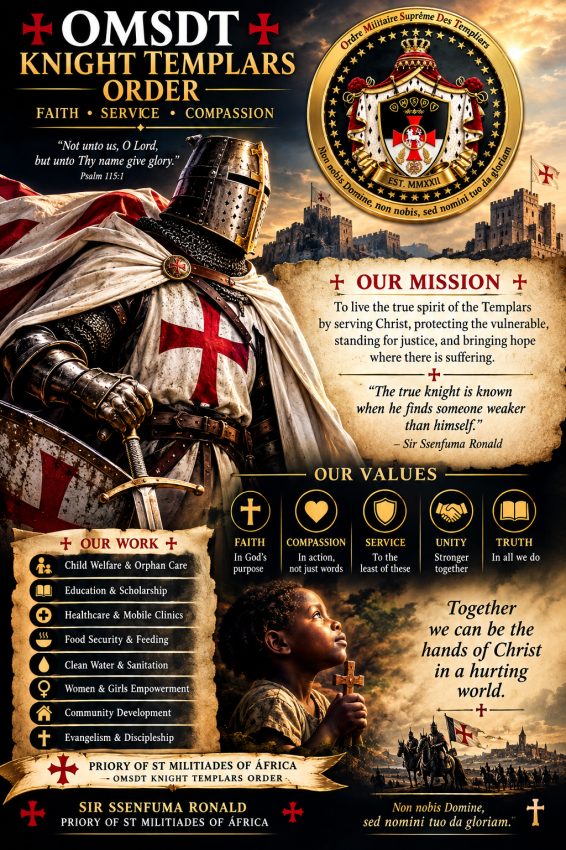
✠ THE CHRONICLE OF THE WHITE MANTLE ✠
A Lost Chronicle Said to Have Been Written in the Holy Land, in the Year of Our Lord 1197
«“Non gladius facit militem, sed misericordia.”
It is not the sword that makes the knight, but mercy.»
---
PROLOGUS
Here Begins the Account of a Deed Which Men Forgot
In the Name of the Father, and of the Son, and of the Holy Spirit.
I, Brother Matthieu, servant of the poor and unworthy keeper of the records of our house, write these things lest they perish from... more✠ THE CHRONICLE OF THE WHITE MANTLE ✠
A Lost Chronicle Said to Have Been Written in the Holy Land, in the Year of Our Lord 1197
«“Non gladius facit militem, sed misericordia.”
It is not the sword that makes the knight, but mercy.»
---
PROLOGUS
Here Begins the Account of a Deed Which Men Forgot
In the Name of the Father, and of the Son, and of the Holy Spirit.
I, Brother Matthieu, servant of the poor and unworthy keeper of the records of our house, write these things lest they perish from the memory of men.
Many chronicles speak of victories.
Many record the names of kings.
Many praise those who conquered cities and returned carrying banners.
But I have learned that Heaven keeps another kind of record.
For the Lord remembers the cup of water given to the thirsty.
He remembers the bread divided when there was little.
He remembers the hand stretched toward the fallen.
And He remembers the knight who turned his horse away from glory because he heard the cry of a child.
Therefore I write of Sir Gabriel of Acre.
Not because he was the greatest knight among us.
But because, when tested, he chose mercy.
And this is the account.
---
✠ CAPUT PRIMUM ✠
Of the Bell That Rang Before Dawn
In the seventh year of the great drought, when the wells of the villages had become bitter and the earth was cracked like old parchment, our fortress stood beneath the pale moon.
The brothers had completed their prayers.
The fires were dying.
The sentries stood upon the walls.
Then, shortly before dawn, the bell sounded.
Once.
Then twice.
Then a third time.
The captain of the watch cried:
“Who goes there?”
No answer came.
Again:
“Who goes there?”
From beyond the gate came only the sound of weeping.
The knights took up their swords.
But Sir Gabriel did not draw his.
He took a lantern.
The captain seized his arm.
“Brother, wait for the guards.”
Gabriel answered:
«“If the voice outside belongs to one who is dying, every moment we wait is another moment they suffer.”»
And he opened the gate.
---
✠ CAPUT SECUNDUM ✠
Of the Child Beneath the Dead Tree
There, beside a dead olive tree, lay a child.
She was perhaps seven winters old.
Her feet were wounded.
Her lips were dry.
Around her neck hung a small wooden cross.
She clutched it with both hands.
Gabriel knelt.
“Child, where is your father?”
No answer.
“Where is your mother?”
The child looked toward the eastern road.
“She told me to wait.”
“For whom?”
“For God.”
At these words, Gabriel lowered his head.
For he understood that the child had waited so long that she had ceased expecting men to return.
He removed his white mantle.
He wrapped it around her.
Then he lifted her into his arms.
The captain asked:
“Sir Gabriel, what shall we do with her?”
Gabriel looked upon the child.
And said:
«“First, we shall make her safe.
Afterwards, we shall ask what must be done.”»
---
✠ CAPUT TERTIUM ✠
The Knight Who Would Not Eat
The child was brought into the fortress.
Bread was placed before her.
She would not eat.
Water was offered.
She drank only a little.
Gabriel sat beside her through the night.
At the third hour, the steward brought him his supper.
The knight pushed the plate away.
“Why do you not eat?” asked the steward.
Gabriel pointed toward the child.
“She has not eaten.”
“There is enough for you both.”
Gabriel shook his head.
“Then divide it.”
The steward divided the bread.
Half for Gabriel.
Half for the child.
But Gabriel quietly broke his half again and placed it beside hers.
The steward protested.
“Brother, you need strength.”
Gabriel answered:
«“Then let my strength begin with giving.”»
And the steward wept.
For he had seen many knights fight for bread.
He had rarely seen one surrender his portion without being asked.
---
✠ CAPUT QUARTUM ✠
The Secret Written Beneath the Mantle
Three days later, the child spoke.
Her name was Miriam.
Her village had been attacked by raiders.
Her father had died.
Her mother had carried her into the hills.
But hunger and sickness overcame her.
Before dying, her mother had placed the wooden cross around Miriam's neck.
And said:
«“When you are afraid, remember that Christ sees you.”»
Gabriel never forgot those words.
From that day forward, he made the child his charge.
But some among the brothers questioned him.
“A knight has duties,” they said.
“You cannot carry every orphan.”
“You cannot rescue every widow.”
“You cannot feed every hungry man.”
Gabriel answered:
«“Perhaps not.”»
Then he looked toward the poor gathered outside the gate.
«“But I can refuse to abandon the one standing before me.”»
---
✠ CAPUT QUINTUM ✠
The Night of Fire
On the Feast of Saint Michael, enemies came upon the fortress.
Their torches appeared like a river of fire upon the hills.
The horns sounded.
The gates were barred.
The knights took their positions.
Gabriel stood upon the wall.
Then he heard something beneath the cries of battle.
Children.
The village below was burning.
Women were fleeing.
The elderly were trapped.
The captain shouted:
“Hold the wall!”
Gabriel looked down.
The fortress was secure.
The people outside were not.
He turned to the commander.
“If we remain here, they will die.”
“We cannot abandon the fortress.”
Gabriel answered:
«“Then open the gate.”»
The commander stared at him.
“You would risk everything?”
Gabriel drew his sword.
“No.”
He looked toward the burning village.
«“I would risk myself.”»
---
✠ CAPUT SEXTUM ✠
The Gate of Mercy
The great gate opened.
Gabriel and a small company rode into the darkness.
They found the villagers scattered among the flames.
A woman carried an infant.
An old man crawled through the dust.
Three children hid beneath a broken cart.
Gabriel dismounted.
He carried the old man.
Another knight carried the infant.
The others gathered the children.
Again and again they returned.
But the enemy drew closer.
“Sir Gabriel!” cried one knight.
“We must go!”
Gabriel looked back.
A little boy stood frozen in the road.
His mother was dead beside him.
Gabriel rode toward him.
The enemy was approaching.
The boy could not move.
Gabriel dismounted.
He lifted him.
And placed the child upon his horse.
Then an arrow struck Gabriel beneath the shoulder.
He fell to one knee.
The young knight cried:
“Brother!”
Gabriel rose again.
Blood ran beneath his armour.
He said only:
«“Take the child.”»
---
✠ CAPUT SEPTIMUM ✠
The Last Stand of the White Mantle
The refugees reached the fortress.
But Gabriel remained outside.
The young knight returned.
“Sir Gabriel! Come!”
Gabriel looked at the closing gates.
Behind them were children.
He heard their crying.
He smiled.
“Close the gate.”
“No!”
“Close it.”
“But you will remain outside!”
Gabriel placed his hand upon the young knight's shoulder.
«“A knight's life is not his own when another life depends upon it.”»
The gates began to close.
The young knight wept.
“Brother Gabriel!”
Gabriel stood alone beneath the burning sky.
His white mantle was torn.
His sword was broken.
His blood stained the earth.
Yet he did not retreat.
Not because he hated those who came against him.
But because behind those walls were people who could not defend themselves.
And so the last thing the young knight saw before the gates closed was the white mantle of Gabriel standing beneath the dawn.
---
✠ CAPUT OCTAVUM ✠
What Was Found at Dawn
When morning came, the knights opened the gate.
There was no sign of Gabriel.
Only his broken sword.
His white mantle.
And beneath it, the small wooden cross that Miriam had once carried.
The commander picked it up.
On the inside of the mantle, sewn into the cloth, they discovered words written in faded thread:
“If I am absent, serve the one who remains.”
The brothers knelt.
No trumpet sounded.
No king came.
No herald announced his name.
Only the poor stood outside the gate.
And Miriam, the little girl he had once found beneath the olive tree, placed her hand upon the bloodstained mantle.
She whispered:
“He told me God had not forgotten me.”
Then she looked toward the sky.
“And now I know why.”
✠ CAPUT NOVISSIMUM ✠
The Law of the White Mantle
Before his death, Gabriel had written seven words upon a piece of parchment.
They became known among the brothers as The Law of the White Mantle:
«“Protect the weak. Feed the hungry. Serve Christ.”»
Beneath them he had written:
«“Let no man call himself a knight merely because he carries a sword.
The true knight is known when he finds someone weaker than himself.”»
And beneath that:
“Where the forgotten are found, there must the servant of Christ be.”
✠ ORATIO ULTIMA ✠
The Prayer of the Knight Before the Last Battle
O Lord Jesus Christ,
Who didst humble Thyself for the salvation of mankind,
Strip from me every pride that prevents me from serving.
Give me eyes to see the forgotten,
ears to hear the cry of the helpless,
hands willing to serve,
and a heart that does not turn away.
When I possess much, teach me to share.
When I possess little, teach me gratitude.
When I am strong, teach me gentleness.
When I am afraid, teach me courage.
And if ever I stand before one who is hungry,
let me not speak of tomorrow.
Let me give him bread today.
If I find a child without shelter,
let me not merely pray for shelter.
Let my hands become the shelter.
If I find the wounded,
let me kneel.
If I find the abandoned,
let me remain.
And when my final hour comes,
let my last breath be spent in service of Thy children.
For I desire no crown that is not first laid before Thee.
No honour that does not become mercy.
No sword that does not defend the innocent.
And no life that has not been poured out in love.
Amen.
✠ EPILOGUS ✠
The Words Written in the Margin
Brother Matthieu records that the manuscript was never placed among the chronicles of kings.
It was kept instead in the room where the poor received bread.
For the brothers believed that its lesson belonged not to princes, but to servants.
Centuries later, the final page was found almost destroyed.
Only one sentence remained.
The letters were faint.
The parchment was blackened around the edges.
Yet the words could still be read:
“When history forgets the names of the knights, Heaven will remember the children they saved.”
And beneath it, written in a different hand:
✠ NON NOBIS, DOMINE.
Not unto us, O Lord.