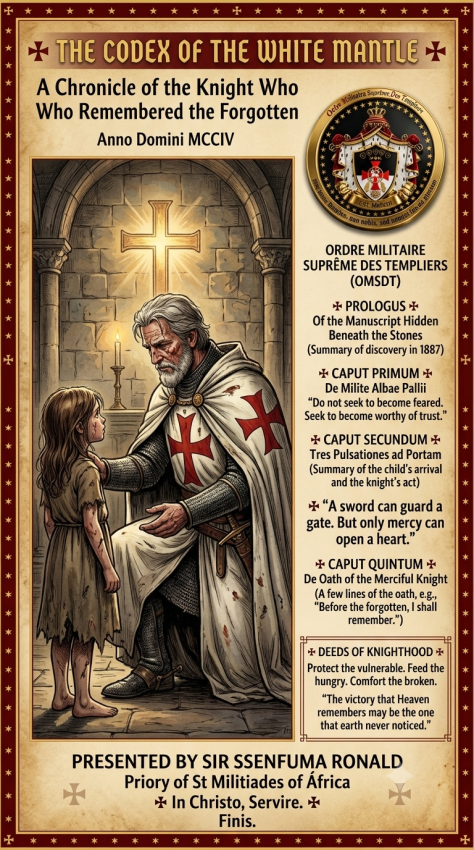
✠ THE CODEX OF THE WHITE MANTLE ✠
A Chronicle of the Knight Who Remembered the Forgotten
Anno Domini MCCIV
In Nomine Patris, et Filii, et Spiritus Sancti.
PROLOGUS
Of the Manuscript Hidden Beneath the Stones
In the winter of the year of Our Lord 1887, when the ruins of an ancient monastery were being cleared by the brethren, there was discovered beneath a fallen altar a chamber sealed with stones blackened by age.
Within that chamber stood an iron chest.
The chest was broken with rust.
... more✠ THE CODEX OF THE WHITE MANTLE ✠
A Chronicle of the Knight Who Remembered the Forgotten
Anno Domini MCCIV
In Nomine Patris, et Filii, et Spiritus Sancti.
PROLOGUS
Of the Manuscript Hidden Beneath the Stones
In the winter of the year of Our Lord 1887, when the ruins of an ancient monastery were being cleared by the brethren, there was discovered beneath a fallen altar a chamber sealed with stones blackened by age.
Within that chamber stood an iron chest.
The chest was broken with rust.
Within it lay fragments of parchment, bound together by leather so old that it crumbled beneath the fingers.
Upon the first leaf were painted a red cross and a single sentence:
“Read this not as a tale of war, but as a lesson in mercy.”
The name of the author had almost disappeared.
Only these words remained:
Brother Matthieu, servant of the Cross and keeper of the deeds of the brethren.
What follows is the portion that could still be read.
CAPUT PRIMUM
De Milite Albae Pallii
Of the Knight of the White Mantle
There lived in the Holy Land a knight called Sir Gabriel of Acre.
For thirty-seven years he had borne the mantle of the Order.
His shield had been broken in battle.
His sword had tasted the dust of many roads.
His armor carried scars like the lines of an ancient map.
He had seen cities burn.
He had seen men die.
He had seen kings rejoice over victories that left widows mourning behind the walls.
And because he had seen these things, he became a quiet man.
When the young knights spoke proudly of battle, Sir Gabriel remained silent.
When they asked him how a knight might become great, he answered:
“Do not seek to become feared. Seek to become worthy of trust.”
And when they asked him what was the strongest weapon of a knight, he answered:
“A heart that still has room for mercy.”
CAPUT SECUNDUM
Tres Pulsationes ad Portam
The Three Knocks at the Gate
It was during a bitter winter.
The moon was hidden.
The wind came down from the hills, carrying snow against the fortress walls.
The brethren had gathered in the chapel for prayer.
Candles burned before the Cross.
The priest began the evening prayers.
Then
Knock.
The brethren became still.
Again
Knock.
The captain looked toward the gate.
Then came the third.
Knock.
Three times.
The captain placed his hand upon his sword.
“No traveler would come in such a storm.”
Sir Gabriel rose from his knees.
“Open the gate.”
“My lord”
“Open it.”
The great doors groaned.
The storm rushed into the courtyard.
And there stood a child.
A little girl.
Barefoot.
Cold.
Alone.
Her clothing was torn.
In her hands she held a small piece of cloth.
The captain asked:
“Where are your parents?”
The child looked toward the ground.
“Gone.”
“Where shall you sleep?”
The child lifted her eyes.
“I do not know.”
Sir Gabriel said nothing.
He removed his white mantle.
He placed it around her shoulders.
Then he carried her through the gate.
CAPUT TERTIUM
Christus Sub Veste Pauperis
Christ Beneath the Garment of the Poor
The child was given bread.
She was given warm clothing.
She was given a place beside the fire.
But Sir Gabriel could not rest.
At midnight he entered the chapel alone.
He knelt before the Cross.
“Lord,” he whispered,
“why did You send her to us?”
The candle trembled.
The chapel remained silent.
Then the words of the Gospel returned to his heart:
“Whatever you did for one of the least of these... you did for Me.”
The old knight lowered his head.
And there, beneath the Cross, he understood.
Perhaps the child had not come asking:
“Will you help me?”
Perhaps Heaven had sent another question:
“Will you recognize Me?”
And the knight wept.
For the first time in many years, he wept not because of the battles he had fought
but because he understood the battle he had almost failed to see.
CAPUT QUARTUM
De Vera Militia
Of True Knighthood
At dawn, Sir Gabriel summoned the younger brethren.
He placed his sword upon the stone floor.
Then his shield.
Then his mantle.
He stood before them without the symbols of rank.
“My brothers,” he said,
“you have learned to fight.”
No one answered.
“You have learned to ride.”
Silence.
“You have learned to defend walls.”
He looked toward the little girl sleeping beside the fire.
“But have you learned to defend the defenseless?”
The young knights lowered their eyes.
Sir Gabriel continued:
«“A sword can guard a gate.
But only mercy can open a heart.”»
He pointed toward the child.
“Remember her.”
Then toward the hungry beyond the walls.
“Remember them.”
Then toward the sick and wounded.
“Remember them.”
Finally, he pointed toward the Cross.
“And remember Him.”
He lifted his sword.
“Let every sword defend the innocent.
Let every shield shelter the weak.
Let every hand be ready to serve.
Let every knight remember that his strength is not his own.”
Then he knelt.
And the young knights knelt with him.
CAPUT QUINTUM
De Oath of the Merciful Knight
The chronicler records that Sir Gabriel taught the brethren this oath:
«Before the Cross of Christ, I shall remember the forgotten.
Before the hungry, I shall not close my hand.
Before the orphan, I shall not close my door.
Before the wounded, I shall not turn away.
Before the helpless, I shall not remain silent.
I shall seek no glory where mercy is required.
I shall seek no praise where service is needed.
And if I possess strength, it shall be used to lift the weak.
If I possess bread, it shall be shared.
If I possess shelter, the stranger shall find refuge.
If I possess hope, I shall give it freely.
For I serve not the pride of men,
but Christ, the King of Mercy.
CAPUT SEXTUM
The Final Battle
Many years passed.
The child became a woman.
She devoted her life to caring for abandoned children.
Sir Gabriel grew old.
His sword remained beside him, but his hands had become too weak to lift it.
One evening she entered his chamber.
The old knight opened his eyes.
“Little one?”
She smiled.
“Yes.”
He took her hand.
“I wondered whether you would come.”
“I could never forget you.”
The knight shook his head.
“Then remember what happened that night.”
“You saved me.”
“No,” he whispered.
“I opened a gate.”
He pointed toward the Cross.
“Christ saved you.”
Tears filled her eyes.
“What shall I do with the life you helped preserve?”
The old knight smiled.
“Give it away.”
She did not understand.
“Give it away?”
“To the forgotten.”
His voice weakened.
“When you see a hungry child, feed them.”
“When you see an orphan, remember their name.”
“When you see someone broken, sit beside them.”
“When you find someone without hope, give them yours.”
His breathing became shallow.
Then came his final words:
«“Do not spend your life trying to become important.
Spend it becoming useful in the hands of God.”»
His eyes closed.
The chapel bell sounded.
Once.
Twice.
Three times.
And Sir Gabriel entered the silence from which no earthly knight returns.
CAPUT SEPTIMUM
The Stone Beneath the Cross
They buried him beneath the chapel.
No golden monument was raised.
No king came.
No trumpet sounded.
His sword was not placed upon his grave.
Only a small wooden cross.
And beneath it they carved:
HE REMEMBERED THE FORGOTTEN.
Brother Matthieu wrote beneath those words:
“I have seen knights win battles and kingdoms lose wars. Yet I tell you this: the victory that Heaven remembers may be the one that earth never noticed.”
ORATIO MILITIS
The Prayer of the Knight
O Domine Jesu Christe,
Lord Jesus Christ,
King of Heaven,
Guardian of the poor,
Defender of the helpless,
teach me to serve before I seek honor.
Give me courage to stand when others flee.
Give me compassion to remain when others turn away.
Give me wisdom to know when to speak.
Give me humility to know when to kneel.
When I see the hungry,
let me remember Your bread.
When I see the orphan,
let me remember Your love.
When I see the wounded,
let me remember Your wounds.
When I see the forgotten,
let me remember Your Cross.
Let my hands serve.
Let my heart forgive.
Let my life give hope.
And when my final hour comes,
let me not ask:
“How many knew my name?”
But:
“Whom did I help?”
Let me not ask:
“How much did I possess?”
But:
“How much did I give?”
Let me not ask:
“Was I honored by men?”
But:
“Was I faithful before You?”
And when I stand before Your throne,
if You should ask:
“Where are the little ones I placed upon your path?”
Let me answer:
«“They were not forgotten, Lord.
I remembered them.
I served them.
I loved them in Your name.”»
Amen.
ULTIMA PAGINA
The Last Writing of Brother Matthieu
The final page was badly damaged.
Only a few lines could be read.
Yet those lines were written in a stronger hand than the rest.
Perhaps they were written near the end of the brother's own life.
«“When the sword has rusted,
when the shield has fallen,
when the white mantle has become dust,
mercy shall remain.”
“When kings are forgotten,
when castles crumble,
when the names of warriors disappear,
the child who was given bread shall remember.”
“Therefore, whoever finds this manuscript,
remember this command:”
“Protect the vulnerable.”
“Feed the hungry.”
“Comfort the broken.”
“Remember the forgotten.”
“And when you have nothing left to give
give hope.”
For this is the mystery of the White Mantle:
the greatest knight is not the man who makes others fear him,
but the man beneath whose shadow the vulnerable are no longer afraid.
Finis.
✠ In Christo, Servire. ✠
In Christ, to serve.»