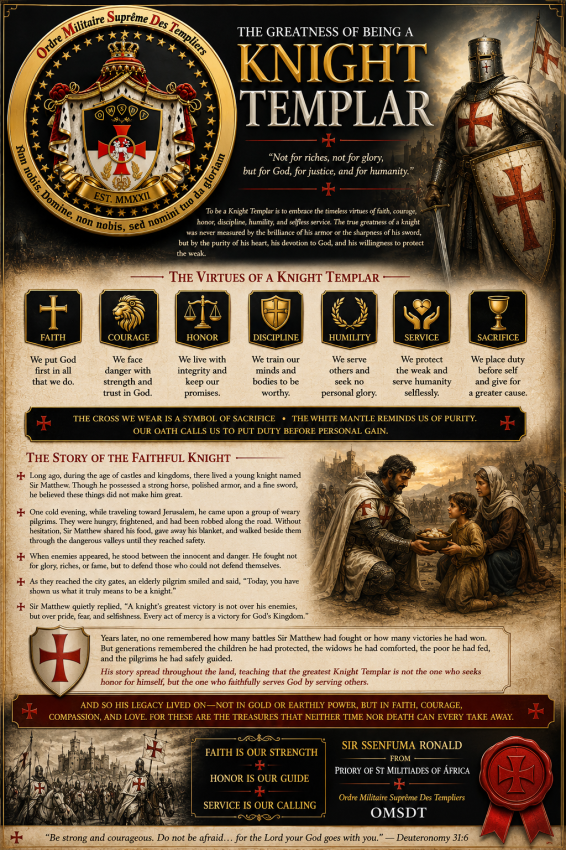
The Greatness of Being a Knight Templar
To be a Knight Templar is to embrace the timeless virtues of faith, courage, honor, discipline, humility, and selfless service. The true greatness of a knight was never measured by the brilliance of his armor or the sharpness of his sword, but by the purity of his heart, his devotion to God, and his willingness to protect the weak.
The medieval Knights Templar were founded in the early 12th century to help protect Christian pilgrims traveling to the Holy... moreThe Greatness of Being a Knight Templar
To be a Knight Templar is to embrace the timeless virtues of faith, courage, honor, discipline, humility, and selfless service. The true greatness of a knight was never measured by the brilliance of his armor or the sharpness of his sword, but by the purity of his heart, his devotion to God, and his willingness to protect the weak.
The medieval Knights Templar were founded in the early 12th century to help protect Christian pilgrims traveling to the Holy Land. They became known for their discipline, their vows, and their commitment to serving a cause greater than themselves.
The cross they wore symbolized sacrifice. Their white mantle reminded them to pursue purity of life. Their oath called them to place duty before personal gain. Whether facing danger on the battlefield or serving those in need, they believed that true strength came from faith, integrity, and obedience to God.
Their legacy continues to inspire many people today not because of myths or hidden treasures but because of the enduring ideals of honor, charity, courage, justice, and compassion. A modern Knight Templar seeks to live these virtues through acts of kindness, protection of the vulnerable, and faithful service to God and humanity.
The Story of the Faithful Knight
Long ago, during the age of castles and kingdoms, there lived a young knight named Sir Matthew. Though he possessed a strong horse, polished armor, and a fine sword, he believed these things did not make him great.
One cold evening, while traveling toward Jerusalem, he came upon a group of weary pilgrims. They were hungry, frightened, and had been robbed along the road. Without hesitation, Sir Matthew shared his food, gave away his blanket, and walked beside them through the dangerous valleys until they reached safety.
When enemies appeared, he stood between the innocent and danger. He fought not for glory, riches, or fame, but to defend those who could not defend themselves.
As they reached the city gates, an elderly pilgrim smiled and said, "Today, you have shown us what it truly means to be a knight."
Sir Matthew quietly replied, "A knight's greatest victory is not over his enemies, but over pride, fear, and selfishness. Every act of mercy is a victory for God's Kingdom."
Years later, no one remembered how many battles Sir Matthew had fought or how many victories he had won. But generations remembered the children he had protected, the widows he had comforted, the poor he had fed, and the pilgrims he had safely guided.
His story spread throughout the land, teaching that the greatest Knight Templar is not the one who seeks honor for himself, but the one who faithfully serves God by serving others.
And so his legacy lived on not in gold or earthly power, but in faith, courage, compassion, and love. For these are the treasures that neither time nor death can ever take away.