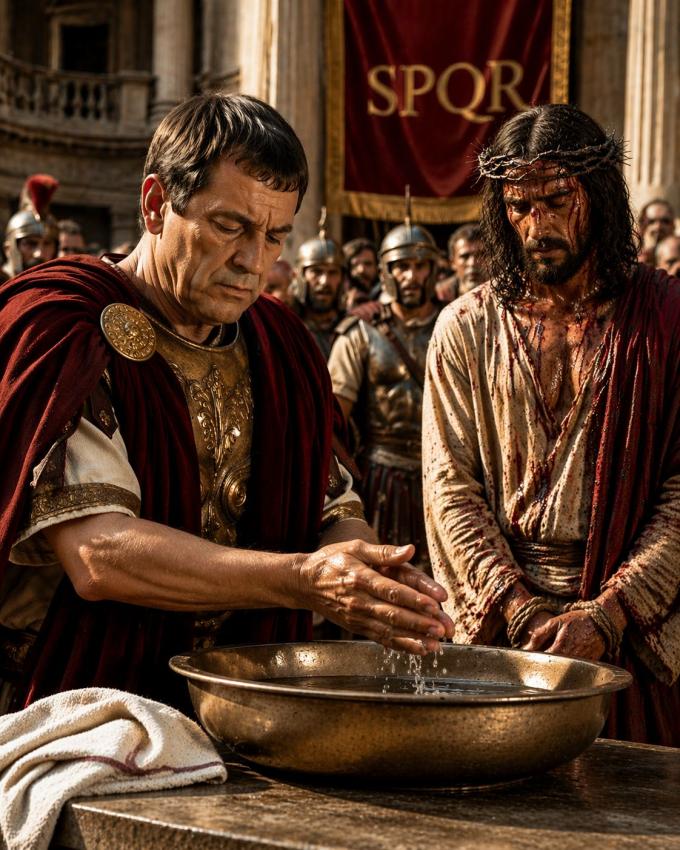
WHEN TRUTH IS REJECTED: THE COST OF WASHED HANDS
“When Pontius Pilate saw that he was getting nowhere, but that instead an uproar was starting, he took water and washed his hands in front of the crowd. ‘I am innocent of this man’s blood,’ he said. ‘It is your responsibility!’” — Matthew 27:24
In one of the most sobering moments in Scripture, Pontius Pilate stands at the intersection of truth, pressure, and personal responsibility. Before him is Jesus Christ—beaten, crowned with thorns, yet und... moreWHEN TRUTH IS REJECTED: THE COST OF WASHED HANDS
“When Pontius Pilate saw that he was getting nowhere, but that instead an uproar was starting, he took water and washed his hands in front of the crowd. ‘I am innocent of this man’s blood,’ he said. ‘It is your responsibility!’” — Matthew 27:24
In one of the most sobering moments in Scripture, Pontius Pilate stands at the intersection of truth, pressure, and personal responsibility. Before him is Jesus Christ—beaten, crowned with thorns, yet undeniably innocent. Pilate had examined Him, questioned Him, and even declared publicly that he found no fault in Him. Yet despite this knowledge, he chose to yield to the voice of the crowd rather than stand on the truth he clearly recognized. This moment exposes a powerful reality: knowing truth is not the same as standing for it. Pilate’s failure was not ignorance—it was the surrender of conviction under pressure.
The act of washing his hands was deeply symbolic. In his mind, it was a declaration of innocence, an attempt to distance himself from the unjust decision that was unfolding. But no outward act can erase an inward compromise. Responsibility cannot be transferred simply because it is inconvenient to carry. Pilate wanted neutrality—he wanted to appear uninvolved while still allowing injustice to proceed. Yet this passage teaches us that neutrality in moments of truth is an illusion. When truth stands before you, silence becomes a decision, and inaction becomes participation. Pilate did not drive the nails, but he authorized the moment. He did not shout with the crowd, but he empowered their voices.
Meanwhile, Jesus Christ stands in profound silence. This silence is not weakness, nor is it defeat. It is the quiet strength of complete surrender to the will of God. While chaos erupted around Him, He remained anchored in purpose. He understood that this moment, though unjust in the eyes of men, was the pathway to redemption for humanity. The contrast is striking: Pilate, a man of power, is shaken and conflicted; Jesus, appearing powerless, is unwavering and resolute. This reveals a deeper truth—true authority is not found in position, but in obedience to God.
The crowd in this scene represents the powerful force of collective pressure. Voices shouting, emotions rising, truth being drowned out by volume rather than discernment. It is a reminder that the majority is not always right, and loudness does not equal truth. Pilate allowed the atmosphere to dictate his decision instead of allowing truth to guide it. How often do we find ourselves in similar situations? Not in a Roman court, but in everyday life—where standing for truth may cost acceptance, comfort, or approval. The temptation to “wash our hands” shows up when we choose silence instead of speaking, compromise instead of conviction, or passivity instead of action.
This teaching calls us to examine our own hearts. Where are we choosing comfort over truth? Where are we allowing pressure—whether from culture, peers, or fear—to shape our decisions? Pilate’s story warns us that avoiding responsibility does not remove accountability. Every decision we make, especially in moments where truth is clear, carries weight. And while Pilate attempted to separate himself from the outcome, history forever ties his name to this moment.
Yet even in this тяжел scene of injustice, there is a greater story unfolding. The suffering of Jesus Christ was not meaningless—it was purposeful. What looked like defeat was actually the beginning of victory. Through this moment, salvation was being secured. Grace was being extended. Love was being demonstrated in its purest form. Jesus did not resist because He was accomplishing something far greater than what any human in that moment could understand. This reminds us that God’s plans are not hindered by human failure. Even when people make wrong choices, God is still able to bring about His perfect purpose.
However, this does not excuse the choices of individuals. Pilate still had a decision to make, and so do we. The presence of God’s sovereignty does not remove human responsibility. Instead, it calls us to align ourselves with truth, to stand boldly, and to choose righteousness even when it is difficult.
Today, this message speaks clearly: do not “wash your hands” when God is calling you to stand. Do not step back when truth requires your voice. Do not trade conviction for comfort. Because in every generation, truth stands before people just as it stood before Pilate—and each person must decide what they will do with it. Will you follow the crowd, or will you stand with truth?
Choose courage. Choose truth. Choose to stand with Jesus Christ.
✠ KLT John Scivoletti ✠
✠ Turco Joan of Arc Priory ✠
✠✠Act and God will Act (Actus et Deus Act)✠✠