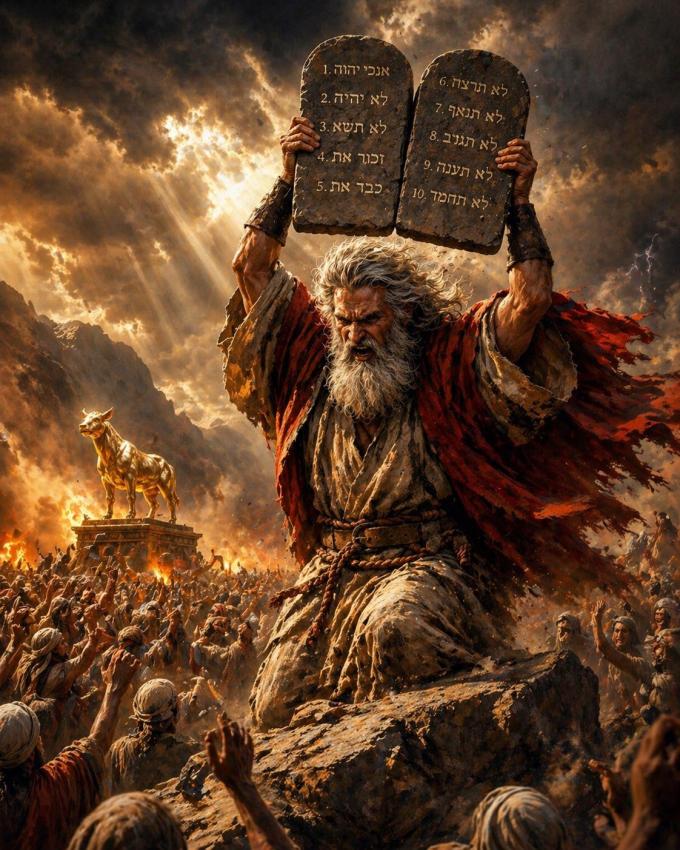
WHEN HOLINESS CONFRONTS IDOLATRY
“Then Moses turned and went down from the mountain, and the two tablets of the Testimony were in his hand… And it came to pass, as soon as he came near the camp, that he saw the calf and the dancing. So Moses’ anger became hot, and he cast the tablets out of his hands and broke them at the foot of the mountain.” — Exodus 32:15,19
God does not take lightly what we often excuse. While Moses was in the presence of God receiving divine instruction, the people below... moreWHEN HOLINESS CONFRONTS IDOLATRY
“Then Moses turned and went down from the mountain, and the two tablets of the Testimony were in his hand… And it came to pass, as soon as he came near the camp, that he saw the calf and the dancing. So Moses’ anger became hot, and he cast the tablets out of his hands and broke them at the foot of the mountain.” — Exodus 32:15,19
God does not take lightly what we often excuse. While Moses was in the presence of God receiving divine instruction, the people below were already turning their hearts toward something else. This moment reveals a deep truth: you can be close to God in position, yet far from Him in devotion.
The golden calf was not just an object—it was a replacement. The people wanted something visible, something controllable, something that fit their desires. And today, many still build “golden calves” in their lives—things they trust, prioritize, and worship over God without even realizing it.
Moses coming down the mountain represents a collision between heaven and earth—between God’s holiness and human compromise. When truth confronts sin, it is never comfortable. It shakes, it exposes, and it demands a response.
The breaking of the tablets was not just anger—it was a symbol. It showed that the covenant had already been broken in the hearts of the people before it was broken in Moses’ hands. God is not after outward obedience alone—He is after the heart.
How often do we ask God to speak, but ignore Him when He does? The people grew impatient waiting for God, so they created their own solution. Impatience can lead us into disobedience faster than we think.
God’s presence is not something to replace—it is something to pursue. When we lose our hunger for Him, we start filling the void with temporary things that can never satisfy. Idolatry isn’t always obvious—it often hides in priorities, habits, and desires.
Moses stood alone in righteousness while surrounded by chaos. This reminds us that standing for God may mean standing apart. You don’t need the approval of the crowd when you have the presence of God.
Yet even in judgment, God’s mercy remains. This story is not just about failure—it is about restoration. God still calls His people back. No matter how far someone drifts, God’s desire is always to bring them back into relationship.
Today is a call to examine your heart. What are you holding onto? What has taken God’s place? Let this be the moment you tear down every “golden calf” and return fully to Him. Because when God moves, everything false must fall.
✠ KLT John Scivoletti ✠
✠ Turco Joan of Arc Priory ✠
✠✠Act and God will Act (Actus et Deus Act)✠✠