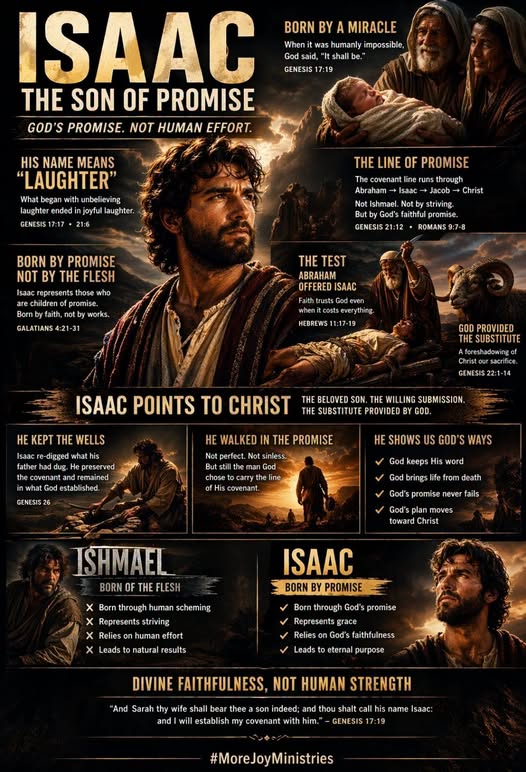
ISAAC: (THE SON OF PROMISE)
Isaac is not just Abraham’s son.
He is one of the clearest pictures in Scripture of what God brings forth by promise, not by human effort.
That is the first thing that has to be understood.
Because Isaac’s birth was not ordinary. Abraham and Sarah were already as good as dead reproductively when God said they would have a son. Romans 4 makes that point plain. This was not a situation where they simply needed better timing. Humanly speaking, it was over. Sarah’s wo... moreISAAC: (THE SON OF PROMISE)
Isaac is not just Abraham’s son.
He is one of the clearest pictures in Scripture of what God brings forth by promise, not by human effort.
That is the first thing that has to be understood.
Because Isaac’s birth was not ordinary. Abraham and Sarah were already as good as dead reproductively when God said they would have a son. Romans 4 makes that point plain. This was not a situation where they simply needed better timing. Humanly speaking, it was over. Sarah’s womb was barren. Abraham was old. The whole setup was impossible from a natural standpoint.
And that is exactly where God likes to work.
Isaac came into the world because God said so.
He was the son of promise.
Genesis 17:19 says, “Sarah thy wife shall bear thee a son indeed; and thou shalt call his name Isaac: and I will establish my covenant with him.” That settles it. Isaac was not a backup plan. He was not Plan B after Ishmael. He was the covenant son God had already determined to bring forth.
His very name is telling.
Isaac comes from the Hebrew root צָחַק (tsachaq), meaning to laugh.
That cuts both ways in the story.
Sarah laughed in unbelief when she first heard she would bear a son in old age. Abraham also laughed in amazement. But then God turned that laughter into reality. What looked impossible became a living child in their arms. What began with unbelieving laughter ended in joyful laughter.
That is Isaac.
He is the reminder that God can turn human weakness into a stage for divine power.
And his birth matters far beyond the family story.
Paul uses Isaac in Galatians 4 as a picture of those who are born according to promise. He contrasts Isaac with Ishmael. Ishmael was born after the flesh. Isaac was born by promise. One represents man’s way. The other represents God’s way. One comes through striving. The other comes through faith in what God said.
A lot of people still live like Ishmael while claiming Isaac.
They say they believe grace, but live like everything depends on their own effort, their own performance, their own religious labor, and their own ability to force results. But Isaac stands as a witness that the things of God do not come by the energy of the flesh. They come by the faithfulness of God.
Isaac was born because God keeps His word.
That is why he is so important in the biblical line.
The covenant line runs through Abraham, then Isaac, then Jacob. Not Ishmael. Not Esau. Isaac is a key link in the chain moving toward the Messiah. The promised seed theme is narrowing. God is drawing the line history will follow until it reaches Jesus Christ.
So when Scripture emphasizes Isaac over Ishmael, it is not arbitrary. God is marking the covenant path.
And Isaac’s life does not stop at his birth.
Genesis 22 gives one of the most powerful scenes in the entire Old Testament.
God tells Abraham to offer Isaac.
That is staggering, because Isaac is not merely a beloved son. He is the promised son. He is the one through whom the covenant line is supposed to continue. So the command strikes at the heart of everything Abraham had received from God.
And yet Abraham obeys.
Hebrews 11 tells us Abraham believed God could raise him from the dead. That means Abraham understood something crucial: if Isaac is the promised son, then even death cannot cancel the promise. Abraham was not trusting his own understanding. He was trusting the God who made the covenant.
Then at the last moment, God stops the sacrifice and provides a ram.
That scene is loaded with meaning.
Isaac, the beloved son, carries the wood up the mountain. Isaac is offered by his father. Isaac is received back figuratively from death. And God provides a substitute.
That is not accidental.
Isaac is not Christ in every detail, but he clearly foreshadows Christ. The typology is too strong to miss. The beloved son. The willing submission. The mountaintop offering. The substitute provided by God. It all points forward.
Even Isaac’s quietness in the narrative is striking. He is not one of the louder personalities in Genesis. Abraham is more dramatic. Jacob is more complex. Joseph is more detailed. Isaac often stands in the middle as the quieter covenant link. But that should not make people overlook him. Quiet does not mean unimportant. Isaac holds the line of promise.
His life also shows the value of settled continuity.
He re-digs wells his father had dug. That may seem small, but it says a lot. Isaac is not obsessed with novelty. He preserves what mattered. He remains in the land God appointed. He walks in the covenant given before him. In a world that constantly wants to invent something new, Isaac is a picture of abiding in what God already established.
Of course, Isaac was still a flawed man.
He showed favoritism between Esau and Jacob. He repeated some of Abraham’s failures in fear. He was not sinless, and the Bible does not pretend otherwise. Scripture never cleans men up into fake heroes. That is one reason the Bible reads like truth. It shows the flaws of the very men through whom God worked.
But Isaac’s weaknesses do not erase his role.
He was still the son of promise. Still the covenant heir. Still the one God chose to carry the line forward.
So what do we learn from Isaac?
We learn that God keeps His word even when the situation looks dead.
We learn that divine promise does not depend on human strength.
We learn that faith rests in what God said, not in what man can calculate.
We learn that what God begins, He is able to carry through, even through impossibility.
And we learn that the promised line was always moving toward Christ.
Isaac matters because he stands in that line as a testimony that salvation history is not built on human power. It is built on divine faithfulness.
Ishmael showed what flesh produces.
Isaac shows what God produces.
Ishmael came through human scheming.
Isaac came through covenant promise.
Ishmael pictures striving.
Isaac pictures grace.
And that is why Isaac belongs in any serious Bible study of the patriarchs.
He is not just Abraham’s son.
He is the son of promise, the covenant heir, and one of the strongest Old Testament witnesses that when God says something, no barrenness, no age, no weakness, and no impossibility can stop Him from bringing it to pass.
✠ Sir John Scivoletti ✠
✠ Turco Joan of Arc Priory ✠
✠✠Act and God will Act (Actus et Deus Act)✠✠