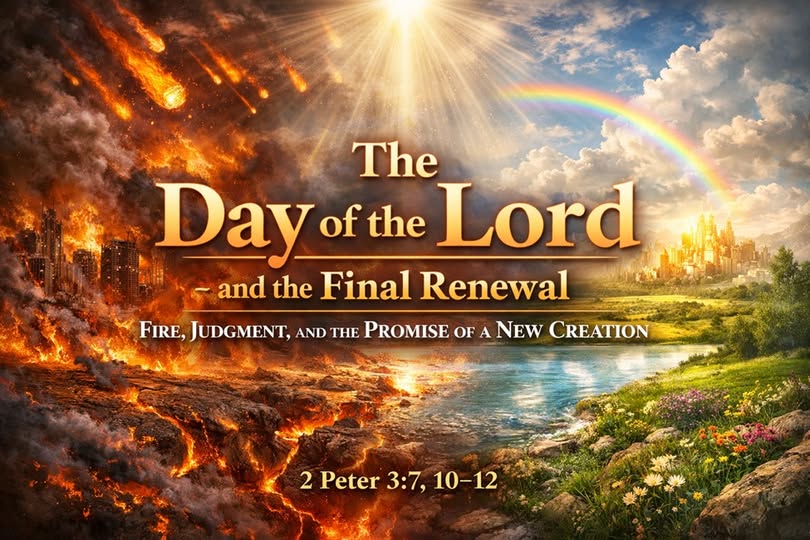
The Day of the Lord and the Final Renewal — Fire, Judgment, and the Promise of a New Creation
Introduction: A Prophecy That Demands Context
Among the most sobering prophetic passages in Scripture are the words of the Apostle Peter in 2 Peter 3. These verses speak of fire, dissolution, judgment, and ultimately, renewal. Yet they are often misunderstood—either exaggerated into total annihilation or minimized into mere symbolism.
The key to understanding this passage lies in context—both immedia... moreThe Day of the Lord and the Final Renewal — Fire, Judgment, and the Promise of a New Creation
Introduction: A Prophecy That Demands Context
Among the most sobering prophetic passages in Scripture are the words of the Apostle Peter in 2 Peter 3. These verses speak of fire, dissolution, judgment, and ultimately, renewal. Yet they are often misunderstood—either exaggerated into total annihilation or minimized into mere symbolism.
The key to understanding this passage lies in context—both immediate and canonical. Peter is not introducing a new idea but building on a consistent biblical theme: God judges to restore.
This chapter carefully re-examines 2 Peter 3:7, 10–12 within the full scope of Scripture, expanding its meaning into a unified theological framework.
1. The Present Creation: Preserved by the Word of God
Peter begins with a striking declaration:
“But the heavens and the earth, which are now, by the same word are kept in store, reserved unto fire against the day of judgment and perdition of ungodly men.” (2 Peter 3:7)
The phrase “by the same word” connects this present world to past divine action. Just as God once judged the world through water in the days of Noah (2 Peter 3:5–6; Genesis 6–9), He now preserves it for a future judgment by fire.
This present heavens and earth refer to the ordered creation restored in Genesis 1:3–2:25, following the initial creative act (Genesis 1:1). God declared this creation “very good” (Genesis 1:31), establishing a world fit for human habitation.
Yet this world is now:
• Fallen (Romans 5:12)
• Subject to corruption (Romans 8:20–22)
• Temporarily preserved for a future divine purpose
Peter emphasizes that this preservation is not passive—it is intentional. Creation is being held in reserve for a specific moment: “the day of judgment.”
2. The Purpose of Fire: Judgment and Purification
Peter identifies the purpose of this future event:
“Reserved unto fire against the day of judgment and perdition of ungodly men.”
This fire is not arbitrary destruction—it is judicial and purifying.
Scripture consistently presents fire as a means of:
• Judgment (Isaiah 66:15–16)
• Testing (1 Corinthians 3:13)
• Purification (Malachi 3:2–3)
Thus, the fire of 2 Peter 3 is not merely destructive—it is transformative.
3. The Day of the Lord: Sudden and Certain
Peter continues:
“But the day of the Lord will come as a thief in the night…” (2 Peter 3:10)
This phrase echoes earlier teaching:
“For yourselves know perfectly that the day of the Lord so cometh as a thief in the night.” (1 Thessalonians 5:2)
The imagery communicates:
• Unexpected arrival
• Inescapable certainty
• Sudden execution
The “Day of the Lord” is not a single 24-hour event, but a prophetic period encompassing divine intervention in human history—culminating in final judgment and renewal.
4. The Dissolution of the Heavens and Earth
Peter describes the event in vivid terms:
“The heavens shall pass away with a great noise, and the elements shall melt with fervent heat…” (2 Peter 3:10)
4.1 “The Heavens Shall Pass Away”
The term “heavens” here most naturally refers to the atmospheric heavens—the immediate environment surrounding the earth (cf. Genesis 1:20).
This is not necessarily the annihilation of the universe, but a radical transformation.
4.2 “With a Great Noise”
The Greek word rhoizedon describes a rushing, roaring sound—suggesting:
• Sudden intensity
• Overwhelming force
• Total engulfment
This is not a quiet transition, but a cosmic upheaval.
4.3 “The Elements Shall Melt”
The term translated “elements” (stoicheia) can refer to:
• Basic components of the physical world
• Foundational structures of the present order
Peter’s language indicates a breaking down of the current system—not necessarily into non-existence, but into a state of dissolution.
The word for “melt” (luō) literally means to loosen, dissolve, or break apart. It suggests:
• Disintegration of present structures
• Release from bondage (cf. Romans 8:21)
4.4 “The Earth Also and the Works Therein Shall Be Burned Up”
This phrase focuses particularly on human activity:
• Works (ergon)—deeds, systems, institutions
• Achievements of fallen humanity
These are consumed—not as an end in themselves, but to remove what cannot endure:
“Yet once more I shake not the earth only, but also heaven… that those things which cannot be shaken may remain.” (Hebrews 12:26–27)
5. Not Annihilation, But Transformation
A crucial question arises: Is Peter describing total destruction or renewal?
The broader testimony of Scripture strongly supports renewal rather than annihilation.
5.1 Biblical Support for Renewal
• “The creation itself also shall be delivered from the bondage of corruption.” (Romans 8:21)
• “They shall perish; but thou remainest… and they shall be changed.” (Hebrews 1:10–12)
• “Behold, I create new heavens and a new earth.” (Isaiah 65:17)
The pattern is consistent:
• Not replacement
• But transformation into a perfected state
5.2 The New Creation
This culminates in the vision given to John the Apostle:
“And I saw a new heaven and a new earth: for the first heaven and the first earth were passed away.” (Revelation 21:1)
And further:
“There shall be no more curse.” (Revelation 22:3)
This is the final state:
• Free from sin
• Free from decay
• Fully aligned with God’s will
6. The Timing: End of the Present Age
Peter’s sequence aligns with the broader prophetic timeline:
• Present age continues under divine patience (2 Peter 3:9)
• The Day of the Lord unfolds
• Final judgment occurs (Revelation 20:11–15)
• Creation is renewed (Revelation 21–22)
Thus, the fiery transformation corresponds with the transition from judgment to eternal state.
7. The Ethical Response: Holy Living
Peter does not present prophecy merely for speculation, but for transformation of life:
“Seeing then that all these things shall be dissolved, what manner of persons ought ye to be in all holy conversation and godliness?” (2 Peter 3:11)
The logic is clear:
• If everything temporal will be dissolved
• Then eternal values must govern present living
7.1 Looking and Longing
“Looking for and hasting unto the coming of the day of God…” (2 Peter 3:12)
Believers are called to:
• Anticipate the future
• Desire God’s ultimate reign
Yet Scripture balances this with divine sovereignty:
“It is not for you to know the times or the seasons, which the Father hath put in His own power.” (Acts 1:7)
8. The Day of God: Final Harmony Restored
Peter ultimately points beyond the Day of the Lord to something greater:
“Nevertheless we, according to his promise, look for new heavens and a new earth, wherein dwelleth righteousness.” (2 Peter 3:13)
This is the Day of God—the eternal state in which:
• God’s rule is absolute (1 Corinthians 15:24–28)
• All rebellion is ended
• Creation is restored to perfect harmony
It is the fulfillment of God’s eternal purpose:
“That in the dispensation of the fullness of times he might gather together in one all things in Christ.” (Ephesians 1:10)
Fire That Leads to Glory
2 Peter 3 is not a message of despair—it is a message of hope through judgment.
Yes, the present world will be shaken.
Yes, human works will be exposed and removed.
Yes, fire will come.
But beyond the fire lies:
• Renewal
• Restoration
• Righteousness dwelling forever
The same Word that created the world,
the same Word that judged it by water,
will also purify it by fire and bring it into eternal glory.
And so, the believer does not fear that day—but looks toward it with expectation:
“Even so, come, Lord Jesus.” (Revelation 22:20)
✠ Sir John Scivoletti ✠
✠ Turco Joan of Arc Priory ✠
✠✠Act and God will Act (Actus et Deus Act)✠✠