
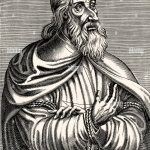

Jacques de Molay: an academic account
Jacques de Molay (c.1243–1314) was the last Grand Master of the Poor Fellow‑soldiers of Christ and of the Temple of Solomon (the Knights Templar). His grand mastership (1292–1314) unfolded during the Order’s post‑Acre phase, when the loss of the Crusader territorial base (Acre, 1291) compelled the Temple to concentrate on estate management, banking operations, and the maintenance of European fortresses. The Order’s transnational wealth and immunities made it an object of royal fiscal interest and a target in the political reconfiguration of late Capetian monarchy.1
Political and ecclesiastical context The initiation of the prosecution against the Templars must be read against Philip IV’s fiscal exigencies and his broader strategy of strengthening royal authority. Philip’s crown had accumulated substantial debts to creditors, among whom the Templars figured prominently; their privileges and corporate autonomy were incompatible with an increasingly centralized fiscal state.2 The election of Bertrand de Got as Pope Clement V (1305) and the relocation of the curia toward Avignon produced a papacy more susceptible to French influence, complicating independent ecclesiastical adjudication.3
Arrests, interrogations, and evidentiary procedures On 13 October 1307 Philip ordered the simultaneous arrest of Templars across his domains. Arrests and interrogations in Paris and provincial courts produced confessions describing grave offences—heresy, idolatrous rites, ritualized blasphemy, and sexual transgressions—but a significant portion of these statements were elicited under torture or the threat of torture and were later retracted or contradicted.4 The papal response, Pastoralis praeeminentiae (October 1307), instructed Christian princes to detain Templars and forward information to Rome, thereby integrating royal actions into a canonical framework and ensuring papal oversight of the inquiries.5
The Chinon proceedings and papal disposition A crucial evidentiary locus for assessing papal policy is the Chinon material (August 1308), preserved in the Vatican Apostolic Archive (Reg. Vat. 297).6 The Chinon parchment records that a papal commission interrogated leading Templars—among them Jacques de Molay and Geoffroy de Charnay—and noted that, after confession and prescribed penance, the pope granted absolution and reconciliation to several senior members.7 The existence of these records complicates narratives that cast the curia as wholly complicit with Philip’s aims: the curial documents indicate a procedural effort to regularize cases canonically and, in some instances, to remit sins once confession and penance occurred, even as pressure from the French crown persisted.8
Suppression, asset disposition, and legal meaning The juridical resolution of the Templar question was formalized at the Council of Vienne (1311–1312). Rather than issuing a blanket canonical condemnation of all members, Clement V promulgated Vox in excelso (22 March 1312), suppressing the Order as a corporate body under canon law.9 Ad providam (2 May 1312) transferred most Templar goods to the Hospitallers, subject to local implementation and exceptions.10 These bulls effected a political and legal settlement: the corporate power of the Temple was extinguished while individual culpability remained case‑specific and unevenly adjudicated across jurisdictions.11
Imprisonment, retractions, and execution The documentary record exhibits oscillation among coerced confessions, retractions, and partial papal reconciliations—an evidentiary landscape marked by legal ambiguity.12 De Molay endured prolonged incarceration and variable treatment; despite the Chinon absolution records, secular proceedings in Paris continued to prioritize royal prerogatives.13 On 18 March 1314 Jacques de Molay and Geoffroy de Charnay were executed by burning on the Île de la Cité. Contemporary chroniclers preserve de Molay’s final protestations of innocence; subsequent legendary accretions (notably alleged “curses” pronounced at the stake) reflect later mythmaking and political dramatization rather than contemporaneous judicial record.14
Historiographical assessment Modern scholarship converges on several points: (1) the prosecution was driven principally by political and fiscal motives on the part of Philip IV; (2) the evidentiary foundation rests largely on statements extracted under duress and therefore has limited probative weight; and (3) the papacy manifested ambivalent agency—seeking canonical propriety and reconciliation for individuals while acquiescing to a political solution that neutralized the Order as a transnational actor.15 The publication of the Chinon documents (modern critical editions and analyses) has nuanced our understanding of papal interventions and underscored the multiplicity of possible outcomes for individual Templars.16
Primary sources and archival evidence For archival citation in scholarly work, the most salient items are:
- Chinon parchment: Vatican Apostolic Archive (Archivio Apostolico Vaticano), Reg. Vat. 297, fols. 1r–v (Chinon commission, 17–20 August 1308).17
- Papal bulls: Vox in excelso (22 March 1312) and Ad providam (2 May 1312), available in standard papal bull collections and printed editions.18
- French royal registers and trial records: various holdings in Archives nationales (Paris) and departmental archives; see published regesta and edited collections for folio‑level references.19
Conclusion The case of Jacques de Molay exemplifies the intersection of medieval political economy, royal centralization, and ecclesiastical jurisprudence. The archival corpus—Chinon records, papal bulls, and royal registers—permits a reconstruction that privileges procedure and context over sensationalist narratives. Interpreting the events of 1307–1314 requires attention to coercive interrogation practices, the contested authority of papal and royal jurisdictions, and the political imperatives that shaped legal outcomes.